Top 25+ Elder Care Business Opportunities [Updated 2025]
As the global population ages, the demand for elder care services continues to rise. Entrepreneurs have a unique chance to make a difference while tapping into this growing market. If you’re considering entering the elder care sector, there are several elder care business opportunities that cater to diverse needs and preferences. In this article, we’ll explore the top elder care business opportunities, discuss why this industry is booming, and share tips for starting your journey in this rewarding field.
Introduction: The Fast-Growing Opportunity in Elder Care
The global elder care industry is experiencing one of the strongest and fastest periods of growth in history. As populations age and life expectancy increases, the demand for high-quality senior support is rising in every part of the world. This makes elder care business opportunities some of the most stable and profitable sectors for new entrepreneurs — especially for women who want to build meaningful, service-driven companies.
According to the World Health Organization (WHO), the number of adults aged 60 and older will reach 2.1 billion by 2050, almost doubling from today’s levels. In the United States alone, the AARP reports that 10,000 Americans turn 65 every single day — a trend that will continue until at least 2034. This demographic shift is creating unprecedented demand for a wide range of senior care business ideas, from in-home care services to transportation support, meal delivery, dementia care, and senior technology services.
At the same time, caregiving shortages are growing. WHO estimates a global shortfall of 15 million caregivers by 2030, meaning families are actively searching for reliable, professional support. This gap opens the door for home care business opportunities, senior care startup ideas, and specialized elderly care services business ideas that help older adults maintain independence, safety, and dignity.
The combination of an aging population, caregiver shortages, rising chronic health conditions, and families seeking modern solutions makes elder care one of the most powerful and resilient markets to enter. Whether you want to create a small local service, develop senior-friendly products, or launch a scalable technology platform, the demand is strong — and will continue to grow for decades.
If you’re exploring aging population business opportunities, this industry offers not just financial potential but the chance to create meaningful impact in the lives of seniors and their families.
Here is the statistics for elderly care market:
![Elderly Care Market Size, Share & Trends | Growth Report [2032]](https://fbi-reports-file.s3.us-west-2.amazonaws.com/fbi_l/img/featured_images/elderly_care_market.webp)
Why Elder Care Is One of the Fastest-Growing Industries
The elder care sector is expanding at a pace few other industries can match. Driven by demographic shifts, lifestyle changes, and increasing pressure on family caregivers, the need for reliable elder support services continues to rise worldwide. This creates a strong environment for elder care business opportunities, especially for women entrepreneurs entering the field with service-driven, compassionate business models.
The Aging Population Is Accelerating Demand
The global population is becoming older faster than at any point in history. According to the World Health Organization, the number of people aged 60+ will grow from 1 billion today to over 2.1 billion by 2050. In the United States, the AARP reports that 10,000 Americans turn 65 every day, a trend that will continue well into the 2030s.
This means millions of older adults will require assistance with daily activities, mobility, transportation, nutrition, medication management, and companionship — creating long-term demand for senior care business ideas and profitable elder care business opportunities.
A Growing Shortage of Caregivers
While the senior population grows, the caregiver workforce is not keeping up. The WHO estimates a global shortage of 15 million caregivers by 2030, leaving families struggling to find qualified support. Many seniors prefer to stay at home for as long as possible, but the lack of caregivers places enormous pressure on adult children and family members.
This shortage opens significant space for:
- in-home care services
- respite care businesses
- dementia care services
- senior transportation businesses
- adult day care programs
These gaps create ideal senior care startup ideas for entrepreneurs who want to enter a high-demand, recession-resistant market.
Rising Demand for At-Home Care Services
More than 90 percent of seniors prefer to age in place, according to AARP. This shift toward aging at home has made non-medical and light medical home care one of the most in-demand segments of the industry.
Families actively seek:
- meal delivery for seniors
- medication reminders
- companionship care
- transportation and errands
- light housekeeping
- mobility support
- home modification services
This rise in home-based demand also fuels interest in mobile medical services, home care business opportunities, and low cost elder care business ideas that don’t require large facilities or high overhead costs.
Rapid Tech Adoption Among Seniors
While older adults used to be seen as slow adopters of technology, the trend has shifted significantly. According to AARP’s latest tech survey:
- 72 percent of adults aged 50+ now use smartphones
- 51 percent use health or fitness apps
- Smart home devices, telehealth, and remote monitoring tools are rapidly increasing
This surge unlocks brand-new elder care business ideas, including:
- senior-friendly apps
- elder care app development
- telemedicine platforms
- safety monitoring systems
- medication reminder apps
- digital companionship services
- smart home integration for seniors
Tech adoption also supports hybrid service models where digital tools complement in-person care.
Thanks to the combination of demographic growth, workforce shortages, and shifting preferences toward at-home and tech-supported care, elder care stands out as one of the fastest-growing and most resilient industries. It offers not only strong financial potential but meaningful ways to support older adults with dignity and independence — making it one of the best elder care businesses to start in 2025 and beyond.

Best Elder Care Business Opportunities
1. In-Home Senior Care Services
What it is
In-home senior care services provide non-medical support to older adults who want to age at home. Services typically include companionship, bathing assistance, dressing, mobility support, meal prep, light housekeeping, medication reminders, errands, and emotional support. This is one of the most high-demand elder care business opportunities because over 90 percent of seniors prefer to remain in their own homes.
Startup cost
2,000–15,000 depending on state registration, basic equipment, caregiver hiring, and insurance. One of the best low cost elder care business ideas.
Profit potential
High. Home care agencies commonly charge 22–35 USD per hour while paying caregivers 13–18 USD per hour. Agencies serving 10–15 recurring weekly clients often earn 8,000–20,000 USD in monthly profit.
Certifications needed
For non-medical care: usually none beyond caregiver training.
For medical home health: requires nursing licenses and agency certification.
Who it’s best for
- Women entrepreneurs
- People with caregiving backgrounds
- Anyone who wants relationship-based work
- Founders seeking profitable senior care business ideas with recurring revenue
2. Senior Transportation Business
What it is
A senior transportation business helps older adults safely travel to medical appointments, grocery stores, community events, social activities, pharmacies, and therapy sessions. Many seniors cannot drive or lack access to public transportation, making this service essential.
Startup cost
3,000–25,000 depending on vehicle type.
Required vehicle types
- Standard 4-door car for ambulatory seniors
- SUV for moderate mobility support
- ADA-compliant van with lift for wheelchair users
Profit potential
Medium to high. Rates range from 35–75 USD per ride depending on distance and assistance level. Weekly recurring medical appointment routes significantly increase revenue.
Certifications needed
Driver’s license and local transportation permit. ADA transport may require training.
Who it’s best for
- Entrepreneurs with a vehicle
- Founders seeking home care business opportunities without caregiving tasks
- Those who enjoy customer service and mobility assistance
3. Assisted Living Facilities
What it is
Assisted living facilities (ALFs) provide housing, meals, supervision, medication management, and daily living support for seniors who can no longer live independently but do not require full nursing home care.
Startup cost
250,000–2 million depending on property size, renovations, staff, and equipment.
Profit potential
Very high. ALFs can earn 300,000–1 million USD annually once fully occupied. This is one of the most profitable elder care business models.
Certifications needed
- State facility license
- Fire safety approvals
- Staff caregiver certifications
- Medication administration qualifications
Who it’s best for
- Investors
- Healthcare professionals
- Entrepreneurs seeking long-term aging population business opportunities
4. Adult Day Care Centers
What it is
Adult day care centers provide structured daytime programs for seniors, offering supervision, meals, exercise, entertainment, games, medical monitoring, and social engagement. Families use this service while working during the day.
Startup cost
30,000–250,000 depending on facility size, staff, insurance, and equipment.
Profit potential
Medium to high. Daily rates typically range from 65–120 USD per participant. Centers with 20–40 regular attendees can generate strong recurring revenue.
Certifications needed
Varies by region, often requiring adult day care licensing and trained staff.
Who it’s best for
- Community-oriented founders
- People who want a structured senior care environment
- Entrepreneurs wanting senior care services in high demand
5. Memory Care Services
What it is
Memory care businesses support seniors living with Alzheimer’s disease, dementia, or cognitive impairment. Services can be provided at home or as a specialized facility and include safety monitoring, brain-health activities, medication reminders, and structured routines.
Startup cost
5,000–20,000 for in-home memory care
300,000–2 million for memory care facilities
Profit potential
High, due to rising dementia rates and specialized expertise. Families often pay higher rates for memory-specific care.
Certifications needed
- Dementia care training
- Alzheimer’s care certifications
- Facility licensing for residential memory care
Who it’s best for
- Caregivers with specialized training
- Healthcare professionals
- Entrepreneurs wanting high-impact elder care business ideas
6. Meal Delivery Services for Seniors
What it is
Meal delivery services for seniors prepare and deliver nutritious, easy-to-digest, senior-friendly meals tailored to dietary needs like low sodium, diabetic-friendly, heart-healthy, soft foods, or high-protein options. This business solves a major problem: many seniors struggle with grocery shopping, cooking, or maintaining balanced nutrition.
Startup cost
2,000–25,000 depending on whether you cook from home, rent a commercial kitchen, or outsource preparation.
Profit potential
Medium to high. Subscription plans (3–14 meals per week) generate steady recurring income. Average monthly revenue per senior ranges from 150–500 USD. Scaling to 50–100 recurring clients creates strong profitability.
Certifications needed
Food handler permit and local kitchen licensing requirements.
Who it’s best for
- Food-service entrepreneurs
- Caregivers who enjoy meal prep
- Founders seeking low cost elder care business ideas with steady recurring revenue
7. Senior Fitness Business
What it is
A senior fitness business focuses on mobility training, balance exercises, low-impact strength workouts, fall-prevention routines, and gentle conditioning for aging adults. With seniors prioritizing independence and longevity, demand for safe, specialized fitness programs continues to increase.
Startup cost
1,000–15,000 depending on online vs in-person sessions and equipment.
Profit potential
Medium to high. Classes, 1:1 sessions, and workshops can earn 30–120 USD per hour. Online programs scale even faster.
Certifications needed
Senior fitness instructor certification or personal training certification with aging specialization.
Who it’s best for
- Fitness instructors
- Physical therapy enthusiasts
- Entrepreneurs targeting senior care services in high demand such as fall prevention and mobility training
8. Senior Home Modification Services
What it is
This business upgrades homes to make them safer and more accessible for older adults. Common modifications include grab bars, handrails, ramps, stair lifts, smart safety devices, non-slip flooring, improved lighting, and bathroom reinforcements.
Startup cost
5,000–50,000 depending on tools, vehicle, and licensing.
Profit potential
High. Jobs often range from 150 USD (simple grab bar installation) to 20,000+ USD for major remodeling. Strong margins due to skilled labor demand.
Certifications needed
Contractor license depending on location. Some regions offer aging-in-place certifications.
Who it’s best for
- Contractors, builders, and handyman professionals
- Entrepreneurs interested in aging population business opportunities
- Founders wanting a scalable, premium-priced service
9. Respite Care Services
What it is
Respite care provides temporary relief for family caregivers by taking over caregiving duties for a few hours, days, or weeks. This service is crucial for families caring for seniors with mobility issues, dementia, or chronic illnesses.
Startup cost
2,000–10,000 depending on staffing and licensing needs.
Profit potential
Medium to high. Services typically charge 20–35 USD per hour or fixed daily rates. Demand is extremely high due to rising caregiver burnout.
Certifications needed
Non-medical respite usually requires basic caregiver training; medical respite requires certified nursing professionals.
Who it’s best for
- Caregivers and CNAs
- Founders who want meaningful work
- Entrepreneurs looking for senior care business opportunities 2025
10. Mobile Medical Services
What it is
Mobile medical services bring healthcare directly to seniors at home. This may include physical exams, blood pressure monitoring, lab tests, vaccinations, chronic disease management, post-surgery care, and medication oversight. It is one of the fastest-growing senior health models due to the shift toward home-based medical care.
Startup cost
20,000–150,000 depending on medical equipment, vehicle, and licensing.
Profit potential
Very high. Medical services are reimbursable through insurance in some regions. Cash-pay visits range from 75–250 USD per appointment.
Certifications needed
Must employ licensed nurses, nurse practitioners, paramedics, or physicians depending on offered services.
Who it’s best for
- Healthcare professionals
- Medical teams wanting mobile care models
- Entrepreneurs entering profitable senior care business ideas with advanced services
11. Senior Tech Assistance
What it is
Senior tech assistance helps older adults learn how to use smartphones, tablets, email, video calls, online banking, telehealth apps, medication reminders, smart home devices, and safety tools. As seniors become more connected, they need patient, personalized help navigating technology confidently.
Startup cost
Very low (200–2,000) for marketing, scheduling tools, and basic equipment.
Profit potential
Medium. Sessions typically cost 25–75 USD per hour. Monthly tech-support memberships can add recurring revenue, increasing total profitability.
Certifications needed
None, though basic IT or device training experience is helpful.
Who it’s best for
Tech-savvy entrepreneurs, patient communicators, and those looking for small elder care business ideas with flexible scheduling.
12. Hospice and Palliative Care
What it is
Hospice and palliative care businesses support seniors with serious illnesses by focusing on comfort, pain management, emotional support, and family education. Services include home visits, symptom monitoring, counseling, and coordination with medical teams.
Startup cost
Medium to high (20,000–200,000) depending on staffing, licensing, medical partnerships, and compliance.
Profit potential
High due to insurance reimbursements and specialized care demand. This sector offers stable, long-term contracts with families seeking compassionate support.
Certifications needed
Licensed nurses, certified palliative care professionals, and agency licensing depending on regulations.
Who it’s best for
Healthcare professionals, end-of-life care specialists, and entrepreneurs who want to offer impactful elder care services.
13. Senior Travel Planning
What it is
Senior travel planners design safe, accessible travel experiences for older adults. This includes selecting senior-friendly accommodations, coordinating transport, arranging medical considerations, choosing low-mobility excursions, and offering group tours.
Startup cost
Low (500–5,000) for certifications, marketing, and travel planning software.
Profit potential
Moderate. Travel planners earn commissions from hotels, cruises, tour companies, and airlines, plus add planning fees. Group senior travel packages increase revenue significantly.
Certifications needed
Travel planning certifications are optional but helpful.
Who it’s best for
Travel lovers, retired caregivers, and entrepreneurs who enjoy planning and organization.
14. Senior Counseling and Mental Health Services
What it is
This business provides mental health support to seniors experiencing loneliness, grief, cognitive decline, major life transitions, retirement stress, or chronic illness. Services can include one-on-one therapy, group sessions, family counseling, and caregiver support.
Startup cost
Low to medium (2,000–20,000) depending on office space, licensing, and practice setup.
Profit potential
High due to growing awareness of senior mental health needs. Private pay rates range 70–180 USD per session.
Certifications needed
Licensed mental health counselor, therapist, psychologist, or social worker certification depending on service level.
Who it’s best for
Mental health professionals, social workers, counselors, and coaches trained in aging populations.
15. Senior-Friendly E-commerce Stores
What it is
Senior-friendly e-commerce stores sell curated products older adults need but often struggle to find locally. Examples include mobility aids, adaptive clothing, arthritis-friendly tools, bathroom safety aids, memory support products, comfort footwear, and senior tech accessories.
Startup cost
Low (1,000–15,000) depending on inventory model (dropshipping vs wholesale).
Profit potential
High due to rising demand and low overhead. Many senior-focused products have strong margins, and e-commerce allows scalable growth beyond local markets.
Certifications needed
None, unless selling medical-grade equipment requiring vendor approval.
Who it’s best for
E-commerce founders, product curators, and entrepreneurs wanting aging population business opportunities with online scalability.
16. Senior App Development
What it is
Senior-focused app development includes creating digital tools that simplify daily life for older adults. Popular concepts include medication reminders, telehealth access, cognitive games, fall detection alerts, caregiving coordination tools, daily check-in apps, and senior-friendly communication platforms. This area is growing rapidly as more seniors adopt smartphones and tablets.
Startup cost
5,000–80,000 depending on the app’s complexity and whether development is done in-house or outsourced.
Profit potential
Very high. Revenue streams can include subscriptions, one-time purchases, ads, caregiver dashboards, or integration partnerships with clinics and senior care agencies. With global senior tech adoption rising, well-designed apps can scale internationally.
Certifications needed
None, though medical apps may require compliance reviews.
Who it’s best for
Tech founders, UX designers, app developers, and entrepreneurs wanting scalable elder care business ideas with minimal physical overhead.
17. VR Experiences for Seniors
What it is
Virtual reality experiences for seniors help improve memory, reduce loneliness, stimulate cognitive activity, support mobility rehabilitation, and offer immersive travel adventures without leaving home. VR is also used in dementia care, pain reduction therapy, and emotional wellness.
Startup cost
3,000–40,000 depending on VR equipment, app development, and software licensing.
Profit potential
Medium to high. Revenue can come from group sessions, subscriptions, facility partnerships, or VR therapy programs delivered to senior living centers.
Certifications needed
None for entertainment; therapy-related VR may require healthcare professional involvement.
Who it’s best for
Innovative entrepreneurs, activity coordinators, senior facility partners, and tech creatives.
18. Nutritional Counseling for Seniors
What it is
Nutritional counseling focuses on personalized diets for seniors with chronic conditions such as diabetes, hypertension, kidney issues, arthritis, or digestive concerns. Services include meal planning, dietary analysis, supplementation guidance, and coaching for healthier lifestyle habits.
Startup cost
Low to medium (2,000–10,000) depending on certification costs and basic equipment.
Profit potential
Medium to high. Counselors charge 60–150 USD per session, with the ability to upsell meal plans, digital products, and monthly support packages.
Certifications needed
Nutritionist or dietitian credentials depending on local regulations.
Who it’s best for
Health professionals, wellness coaches, and entrepreneurs passionate about senior health and longevity.
19. Senior Fitness Equipment Rentals
What it is
This business rents lightweight, senior-friendly exercise equipment like resistance bands, balance boards, pedal bikes, mini treadmills, seated ellipticals, and stretching tools. Rentals support seniors who prefer at-home fitness without buying expensive equipment.
Startup cost
5,000–25,000 depending on initial equipment inventory.
Profit potential
Medium. Monthly rental fees range from 30–150 USD per item, with high recurring revenue potential and low maintenance costs.
Certifications needed
None, though fitness knowledge is helpful for recommending equipment.
Who it’s best for
Fitness entrepreneurs, rental businesses, or founders wanting recurring income with minimal overhead.
20. Senior Errand and Concierge Services
What it is
Senior errand and concierge services help older adults with grocery shopping, prescription pickups, appointment scheduling, mail management, home organization, bill payments, and general assistance tasks that support daily independence. Read more about growing your coaching business here.
Help seniors live fulfilling lives and document their legacy by offering:
- Guidance on achieving life goals post-retirement.
- Memoir writing and personal history documentation.
- Estate planning and family legacy workshops.
Startup Tip: Promote services through senior centers and libraries.
Startup cost
Very low (300–3,000) for marketing and transportation.
Profit potential
Medium to high. Rates typically range from 25–50 USD per hour. Packages and monthly memberships offer steady income.
Certifications needed
None.
Who it’s best for
People who enjoy assisting others, want flexible service-based work, or seek small elder care business ideas with low startup costs.
21. Senior Companionship Services
What it is
Senior companionship services focus on providing emotional support, conversation, light activities, games, walks, and social engagement for older adults who feel isolated or lonely. Companions do not perform medical care but offer essential emotional and social support that dramatically improves quality of life.
Startup cost
Very low (200–3,000) for marketing, background checks, and scheduling tools.
Profit potential
Medium to high. Companionship rates typically range from 18–35 USD per hour. Many families book recurring daily or weekly visits, generating stable ongoing revenue.
Certifications needed
None for non-medical companionship, though caregiver training helps.
Who it’s best for
People who enjoy talking, listening, and connecting with seniors; ideal for women entrepreneurs entering elder care.
22. Senior Financial Planning Services
What it is
This business offers financial guidance to seniors who need help managing budgets, bills, insurance, retirement funds, fraud protection, and estate planning. Many older adults struggle with online banking, financial organization, and avoiding scams, making this a fast-growing opportunity. Here you can learn more about how to start your coaching business.
Startup cost
Low to medium (1,000–10,000) depending on certifications and tools.
Profit potential
High. Advisors can charge 70–200 USD per session or offer ongoing monthly financial management packages.
Certifications needed
Financial advisor certification is recommended. Some services, like bill pay support, may not require licensing.
Who it’s best for
CPAs, bookkeepers, financial planners, and detail-oriented entrepreneurs.
23. Senior Mobility Equipment Rentals
What it is
Senior mobility equipment rentals provide wheelchairs, walkers, scooters, rollators, canes, and temporary rehabilitation devices for seniors recovering from surgery or dealing with short-term mobility challenges. Many families prefer renting over buying expensive equipment.
Startup cost
10,000–50,000 for initial inventory and delivery vehicles.
Profit potential
Medium to high. Rental fees range from 40–200 USD per month depending on equipment type. Repairs and upsells add additional revenue.
Certifications needed
None, though vendor certification may be required for medical-grade devices.
Who it’s best for
Entrepreneurs with logistics or rental business experience.
24. Senior Cleaning and Housekeeping Services
What it is
Senior-focused cleaning services offer light housekeeping, laundry, dusting, kitchen cleaning, bedroom tidying, safety-focused organization, and home decluttering. Seniors often need reliable, gentle cleaning services adapted to their mobility and health needs.
Startup cost
Low (500–5,000) mainly for supplies and transportation.
Profit potential
Medium. Cleaning rates range from 25–60 USD per hour, with many seniors booking weekly or twice-weekly service.
Certifications needed
None.
Who it’s best for
Cleaning business owners, service-focused entrepreneurs, and individuals who enjoy helping seniors maintain safe homes.
25. Senior Pet Care Assistance
What it is
Senior pet care assistance helps older adults manage pet responsibilities like dog walking, feeding, litter box help, medicine administration, grooming transport, and vet appointments. Many seniors want to keep their pets but struggle with physical tasks.
Startup cost
Very low (200–2,000).
Profit potential
Medium. Pet care services often charge 15–40 USD per visit or walking session. Upsells include grooming transport and in-home overnight pet sitting.
Certifications needed
None.
Who it’s best for
Animal lovers and caregivers seeking small, flexible elder care business ideas.
26. Senior Meal Prep and Grocery Assistance
What it is
This service helps seniors with grocery shopping, meal planning, recipe preparation, portioning, and refrigerator organization. It supports seniors who can still cook but need help with heavy items, planning, or nutrition.
Startup cost
500–5,000 depending on tools and transportation.
Profit potential
Medium. Session fees range from 25–50 USD per hour, with many clients booking weekly meal prep.
Certifications needed
Food handler certification may be required depending on location.
Who it’s best for
Caregivers, cooks, meal-prep entrepreneurs, and founders seeking low cost elder care business opportunities.
Most Profitable Elder Care Business Ideas
The elder care industry includes both low-cost service businesses and high-investment models, but profitability varies widely depending on licensing, staffing, and scalability. The most profitable elder care business opportunities tend to offer recurring revenue, specialized services, or high-value care. Below is a clear breakdown of which elder care business ideas generate the strongest financial returns in 2025 and beyond.
Profitable senior care business ideas generally fall into two groups:
- High-profit businesses with low startup costs (fast to launch, quick cash flow)
- High-profit businesses with high investment (long-term but scalable)
This section helps you understand which business model fits your budget, goals, and experience level.
High-Profit Elder Care Businesses (Top Tier)
These business ideas generate strong revenue and often benefit from long-term client relationships or specialized services.
- In-home senior care services
- Assisted living facilities
- Memory care business
- Mobile medical services
- Senior home modification services
- Hospice and palliative care services
- Senior app development
- Senior transportation (specialized, ADA-compliant)
- Adult day care centers
These businesses have high demand, strong repeat customers, and the ability to scale through staff, vehicles, facilities, or technology.
Low-Cost Elder Care Business Ideas With High Profit Margins
These are ideal for new entrepreneurs, especially women looking to enter the senior care sector with minimal startup costs.
- Senior tech assistance
- Senior errand and concierge services
- Senior companionship services
- Meal prep and grocery assistance
- Senior fitness coaching
- Senior-friendly e-commerce stores
- Nutritional counseling
- Senior pet care assistance
- Senior travel planning
- Senior cleaning services
Most of these can be launched with under 3,000–10,000 USD and scale quickly through repeat clients and service packages.
Elder Care Business Opportunities: Profitability Comparison Table
Here is a clear breakdown comparing each major elder care business category based on startup cost, earning potential, and scalability.
| Business Idea | Startup Cost | Profit Potential | Scalability | Why It’s Profitable |
|---|---|---|---|---|
| In-home senior care services | Low–Medium | Very high | High through staffing | Recurring weekly clients and rising demand |
| Assisted living facilities | High | Very high | Very high | Long-term residents and premium care rates |
| Memory care services | Medium–High | Very high | High | Specialized care with higher pricing |
| Mobile medical services | Medium–High | Very high | High | Medical reimbursements and essential demand |
| Senior home modification services | Medium | High | Medium–High | High-priced installation jobs and aging-in-place trends |
| Adult day care centers | Medium–High | High | Medium | Multiple daily participants create predictable income |
| Hospice and palliative care | Medium–High | Very high | High | Insurance reimbursement and steady referrals |
| Senior tech assistance | Low | Medium | Medium | Large aging population using smartphones and apps |
| Senior companionship services | Low | Medium–High | Medium | High emotional value and recurring weekly visits |
| Senior errand services | Very low | Medium | Medium | Quick setup and consistent client needs |
| Senior cleaning services | Low | Medium | Medium | Recurring weekly or biweekly tasks |
| Senior pet care assistance | Very low | Medium | Medium | Seniors rely on regular support to keep pets |
| Meal delivery for seniors | Low–Medium | Medium–High | High with subscriptions | Recurring meal plans and limited competition |
| Nutritional counseling | Low | Medium–High | Medium | Specialized dietary needs in seniors |
| Senior fitness coaching | Low | Medium–High | Medium | High demand for mobility and balance training |
| Senior-friendly e-commerce | Low–Medium | Medium–High | High | Growing online demand for senior products |
| Senior app development | Medium–High | Very high | Very high | Scaling potential and rising senior tech adoption |
| VR experiences for seniors | Medium | Medium | Medium | Use in memory care and therapy programs |
| Senior travel planning | Low | Medium | Low–Medium | Niche specialization and commissions |
Which Elder Care Business Generates the Highest Profit?
Based on industry data, the most profitable elder care business ideas in 2025 are:
- Assisted living facilities
- Memory care centers
- Mobile medical services
- In-home senior care agencies
- Hospice and palliative care
- Senior home modification services
- Senior app development
- Adult day care centers
These models combine high demand, scalable business structures, and long-term client relationships.
Which Elder Care Business Has the Best Profit Potential With Low Startup Costs?
If you want to start an elder care business with little money but high upside, the best options are:
- Senior companionship services
- Senior tech assistance
- Senior errand and concierge services
- Meal prep and grocery assistance
- Senior-friendly e-commerce
- Senior fitness coaching
- Nutritional counseling
- Senior pet care services
These require minimal licensing, offer flexible hours, and can scale locally without major capital investment.
Low-Cost Elder Care Business Opportunities
Not every elder care business requires a large investment or specialized licensing. Many service-based opportunities can be launched with a small budget of 500 to 3,000 USD, making them ideal for first-time entrepreneurs, women-led businesses, retirees, part-time founders, or anyone exploring senior care with low risk. These lower-cost elder care business ideas still benefit from strong demand, recurring appointments, flexible scheduling, and high long-term earning potential.
Below is a full breakdown of the most accessible, low-cost elder care business opportunities you can start quickly with minimal equipment and training.
Senior Companionship Services
What it is
Provides emotional support, conversation, games, walks, reading assistance, and companionship to older adults who experience loneliness or want social interaction. No medical care is provided, making it one of the simplest senior care business ideas to launch.
Startup cost
200–2,000 for marketing, basic training, transportation, and scheduling tools.
Profit potential
Medium to high. Companionship visits often become long-term weekly or daily appointments, creating dependable recurring income.
Who it’s best for
People who enjoy connecting with seniors, women entrepreneurs, or anyone seeking low barrier elder care business opportunities.
Senior Errand and Concierge Services
What it is
Supports seniors with grocery shopping, prescription pickups, paperwork delivery, household errands, appointment scheduling, and daily task assistance. Helps older adults maintain independence without relying on family.
Startup cost
300–1,500 for local permits, branding, and fuel.
Profit potential
Medium. Clients often book recurring weekly services, and family members often sponsor packages for their parents.
Who it’s best for
Organized, reliable individuals who enjoy helping people one-on-one.
Senior Tech Assistance
What it is
Teaches seniors how to use smartphones, tablets, email, video calls, telehealth apps, online banking, and safety or health monitoring devices. Tech adoption among seniors is rising fast, creating strong demand for personalized assistance.
Startup cost
200–800 for basic equipment and advertising.
Profit potential
Medium. Hourly sessions, package deals, and monthly support memberships can generate strong recurring income.
Who it’s best for
Tech-savvy individuals, patient communicators, and those seeking small elder care business ideas with minimal startup costs.
Senior Meal Prep and Grocery Assistance
What it is
Helps seniors plan meals, shop for groceries, organize their refrigerators, prep healthy dishes, and ensure nutritional needs are met. This service supports seniors who can still cook but struggle with heavy items or planning.
Startup cost
500–2,000 depending on tools and transportation.
Profit potential
Medium. Weekly meal prep appointments are common and can generate stable revenue.
Who it’s best for
Caregivers, meal prep enthusiasts, retired cooks, or anyone who enjoys supportive, practical service roles.
Senior Cleaning and Housekeeping Services
What it is
Offers light cleaning tailored to seniors’ mobility needs, including laundry, dusting, kitchen cleaning, bathroom help, safety-focused decluttering, and organization to prevent falls.
Startup cost
300–2,500 for cleaning supplies and local advertising.
Profit potential
Medium to high. Weekly and twice-weekly sessions can quickly fill a schedule and lead to consistent recurring income.
Who it’s best for
Cleaners, homemakers, or entrepreneurs wanting to expand into senior care niches.
Senior Pet Care Assistance
What it is
Supports seniors with walking pets, feeding, grooming transport, cleaning litter boxes, administering simple medications, and attending vet appointments. This allows seniors to keep beloved pets even if mobility becomes difficult.
Startup cost
200–1,500 depending on supplies and transportation.
Profit potential
Medium. Daily dog walking, pet sitting, or grooming pick-up services create stable, repeatable revenue.
Who it’s best for
Animal lovers and caregivers seeking flexible small elder care business ideas.
Senior Travel Planning
What it is
Helps older adults plan safe, accessible vacations or trips to visit family. Services may include transportation coordination, medical requirement checks, accessible hotel planning, and group senior travel programs.
Startup cost
500–3,000 for certifications, marketing, and booking tools.
Profit potential
Moderate, with strong upside from commissions, package pricing, and group travel planning.
Who it’s best for
Travel lovers, organized planners, and entrepreneurs focused on lifestyle-based senior care services.
Senior Fitness Coaching
What it is
Provides gentle fitness training for older adults, including balance training, fall-prevention routines, mobility exercises, flexibility sessions, and strength conditioning.
Startup cost
800–3,000 for certification, insurance, and basic portable fitness equipment.
Profit potential
Medium to high depending on classes, 1:1 clients, and specialty programs.
Who it’s best for
Personal trainers, physical therapy assistants, or wellness-minded entrepreneurs.
Nutritional Counseling for Seniors
What it is
Offers tailored dietary guidance for seniors with diabetes, hypertension, heart conditions, arthritis, or digestive issues, plus meal planning for long-term wellness.
Startup cost
1,000–3,000 depending on certification and practice setup.
Profit potential
Medium to high, with private sessions, group workshops, and subscription meal planning.
Who it’s best for
Nutritionists, dietitians, health coaches, or wellness entrepreneurs.
Senior-Friendly E-commerce Stores
What it is
Sells curated senior products online such as mobility aids, arthritis-friendly gadgets, adaptive clothing, bathroom safety items, senior tech accessories, and comfort products.
Startup cost
1,000–3,000 if using dropshipping or low-inventory models.
Profit potential
Medium to high with strong scaling potential through SEO and social media.
Who it’s best for
E-commerce founders, product curators, and entrepreneurs who want online-first elder care business opportunities.
Best Low-Cost Elder Care Businesses Under $3,000: Summary Table
| Business Idea | What It Is | Startup Cost | Profit Potential | Certifications Needed | Best For |
|---|---|---|---|---|---|
| Senior companionship services | Social visits, conversation, activities, emotional support | 200–2,000 | Medium to high through recurring weekly visits | None | People who enjoy connecting with seniors |
| Senior errands and concierge services | Grocery shopping, pharmacy runs, paperwork, appointments | 300–1,500 | Medium with weekly recurring tasks | None | Organized helpers and service-minded founders |
| Senior tech assistance | Teaching seniors to use phones, apps, online tools | 200–800 | Medium through hourly sessions and memberships | None | Tech-savvy communicators |
| Senior meal prep and grocery assistance | Meal planning, shopping, prepping dishes | 500–2,000 | Medium with weekly sessions | Food handler permit in some regions | Meal-prep oriented entrepreneurs |
| Senior cleaning and housekeeping | Light cleaning, safety-focused decluttering, laundry | 300–2,500 | Medium to high with weekly/biweekly service | None | Cleaning and service business founders |
| Senior pet care assistance | Walking pets, feeding, vet transport, grooming transport | 200–1,500 | Medium with daily walks and visits | None | Animal lovers |
| Senior travel planning | Planning safe, accessible senior-friendly travel | 500–3,000 | Moderate with commissions and group trips | Optional travel planner certification | Travel-focused entrepreneurs |
| Senior fitness coaching | Balance training, mobility workouts, fall prevention | 800–3,000 | Medium to high via 1:1 or group sessions | Senior fitness instructor certification | Trainers and wellness coaches |
| Nutritional counseling for seniors | Personalized diets for chronic conditions | 1,000–3,000 | Medium to high through sessions and meal plans | Nutritionist/dietitian credentials | Wellness and nutrition professionals |
| Senior-friendly e-commerce | Selling curated mobility and comfort products | 1,000–3,000 | Medium to high with strong scaling potential | Vendor approval for medical items | E-commerce founders |
These opportunities require little equipment, minimal certification, and can be started part-time or full-time depending on your goals.
Top 10 Elder Care Business Opportunities: Real Earning Models and Revenue Examples
These examples are based on 2025 U.S. averages and can be adapted for any region.
1. In-Home Senior Care Services (Non-Medical)
Pricing: 26–32 USD per hour
Typical client load: 8–14 recurring clients
Monthly revenue example:
10 clients × 16 hours/week × 4.3 weeks × 28 USD = 19,264 USD
Expenses:
Caregiver wages (55%): 10,595
Insurance + admin: 1,100
Marketing: 500
Misc. labor + taxes: 750
Estimated total expenses: 12,945
Net profit:
19,264 – 12,945 = 6,319 USD/month
Real 2025 scenario:
New agencies commonly reach 6,000–12,000 USD per month once they secure 8–12 weekly clients.
2. Senior Transportation Business
Pricing: 30–45 USD per trip
Typical load: 4–6 trips per day
Monthly revenue example:
5 trips/day × 22 days × 38 USD = 4,180 USD
Expenses:
Fuel: 350
Insurance: 150
Vehicle payment/repairs: 350
Phone + scheduling: 50
Total expenses: 900
Net profit:
4,180 – 900 = 3,280 USD/month
Real 2025 scenario:
Single-vehicle operators earn 3,000–5,500 USD/month.
Multi-vehicle teams can reach 8,000–15,000 USD/month.
3. Assisted Living Facility (Small Residential)
Pricing: 3,500–6,800 USD per resident per month
Typical occupancy: 6–12 residents in a residential home model
Monthly revenue example (8 residents):
8 × 4,200 = 33,600 USD
Expenses:
Staff wages: 14,000
Food + supplies: 2,000
Utilities + maintenance: 1,800
Insurance + compliance: 1,500
Admin + misc: 1,200
Total expenses: 20,500
Net profit:
33,600 – 20,500 = 13,100 USD/month
Real 2025 scenario:
Small facilities average 10,000–25,000 USD/month profit once stable.
4. Adult Day Care Center
Pricing: 65–120 USD per day
Typical attendance: 12–25 seniors
Monthly revenue example:
15 seniors × 85 USD/day × 22 days = 28,050 USD
Expenses:
Staff: 12,000
Rent: 3,000
Food + activities: 1,200
Insurance: 550
Transportation (optional): 600
Total expenses: 17,350
Net profit:
28,050 – 17,350 = 10,700 USD/month
Real 2025 scenario:
Most centers earn 8,000–20,000 USD/month depending on attendance.
5. Memory Care Services (Home-Based)
Pricing: 28–45 USD per hour
Typical load: 6–10 dementia care clients
Monthly revenue example:
7 clients × 12 hours/week × 4.3 weeks × 35 USD = 12,678 USD
Expenses:
Caregiver wages: 6,800
Insurance: 300
Training + certifications: 200
Admin + marketing: 400
Total expenses: 7,700
Net profit:
12,678 – 7,700 = 4,978 USD/month
Real 2025 scenario:
Solo dementia specialists commonly earn 4,000–8,500 USD/month.
6. Meal Delivery for Seniors
Pricing: 10–15 USD per meal or monthly package
Typical load: 30–60 meals/week
Monthly revenue example:
40 meals/week × 4.3 weeks × 12 USD = 2,064 USD
Plus weekly packages (10 clients × 60 USD weekly × 4.3): 2,580 USD
Total revenue: 4,644 USD/month
Expenses:
Ingredients: 1,200
Containers: 150
Fuel: 150
Kitchen rental (if needed): 300
Total expenses: 1,800
Net profit:
4,644 – 1,800 = 2,844 USD/month
Real 2025 scenario:
Most founders earn 2,000–6,500 USD/month depending on scale.
7. Senior Fitness Coaching
Pricing: 40–80 USD per session
Typical load: 20–30 sessions per week
Monthly revenue example:
25 sessions/week × 4.3 × 55 USD = 5,912 USD
Expenses:
Travel: 150
Equipment: 50
Insurance: 70
Marketing: 100
Total expenses: 370
Net profit:
5,912 – 370 = 5,542 USD/month
Real 2025 scenario:
Solo senior fitness trainers typically earn 4,000–8,000 USD/month.
8. Senior Home Modification Services
Pricing range: 150–15,000 USD depending on job
Typical project load: 8–12 jobs per month
Monthly revenue example:
4 small jobs × 250 = 1,000
3 medium jobs × 1,500 = 4,500
1 large job × 8,000 = 8,000
Total revenue: 13,500 USD/month
Expenses:
Materials: 4,000
Labor (if hired): 3,500
Tools + fuel: 300
Insurance: 200
Total expenses: 8,000
Net profit:
13,500 – 8,000 = 5,500 USD/month
Real 2025 scenario:
Established contractors earn 7,000–18,000 USD/month consistently.
9. Respite Care Services
Pricing: 22–40 USD/hour or 120–250 USD/day
Typical load: 10–20 hours per week per client
Monthly revenue example:
6 clients × 10 hours/week × 4.3 × 30 USD = 7,740 USD
Expenses:
Caregiver labor: 4,200
Insurance: 250
Scheduling tools: 80
Marketing: 150
Total expenses: 4,680
Net profit:
7,740 – 4,680 = 3,060 USD/month
Real 2025 scenario:
Respite providers usually make 3,000–8,000 USD/month.
10. Senior Tech Assistance
Pricing: 30–75 USD/hr
Typical load: 15–25 hours/week
Monthly revenue example:
20 hours/week × 4.3 × 50 USD = 4,300 USD
Expenses:
Fuel: 150
Marketing: 120
Basic tools: 30
Total expenses: 300
Net profit:
4,300 – 300 = 4,000 USD/month
Real 2025 scenario:
Tech helpers commonly earn 3,500–7,000 USD/month with minimal overhead.
Comparison Table: Top 10 Elder Care Business Earning Models
| Business Type | Typical Pricing | Typical Client Load | Monthly Revenue Example | Monthly Expenses | Net Profit Estimate | Profit Margin |
|---|---|---|---|---|---|---|
| In-home senior care services | 26–32 USD/hr | 8–12 clients | 19,264 USD | 12,945 USD | 6,319 USD | ~44% |
| Senior transportation | 30–45 USD/trip | 4–6 trips/day | 4,180 USD | 900 USD | 3,280 USD | ~80% |
| Assisted living facility (small) | 3,500–6,800 USD/resident | 6–12 residents | 33,600 USD | 20,500 USD | 13,100 USD | ~39% |
| Adult day care center | 65–120 USD/day | 12–25 participants | 28,050 USD | 17,350 USD | 10,700 USD | ~38% |
| Memory care (home-based) | 28–45 USD/hr | 6–10 clients | 12,678 USD | 7,700 USD | 4,978 USD | ~39% |
| Senior meal delivery | 10–15 USD/meal | 30–60 meals/week | 4,644 USD | 1,800 USD | 2,844 USD | ~61% |
| Senior fitness coaching | 40–80 USD/session | 20–30 sessions/week | 5,912 USD | 370 USD | 5,542 USD | ~94% |
| Senior home modification | 150–15,000 USD/job | 8–12 jobs/month | 13,500 USD | 8,000 USD | 5,500 USD | ~41% |
| Respite care services | 22–40 USD/hr | 6–10 clients | 7,740 USD | 4,680 USD | 3,060 USD | ~40% |
| Senior tech assistance | 30–75 USD/hr | 15–25 hrs/week | 4,300 USD | 300 USD | 4,000 USD | ~93% |
Senior Care Business Founders Stories
Case Study 1: How Susan Turned $1,500 Into a Senior Companionship Business
Susan, a former receptionist, started a senior companionship service in her small town with just 1,500 USD in savings. She used the money to print brochures, set up a simple website, and place ads in local community groups. Within two months, she secured her first four clients through referrals from a local senior center and church group. By month six, she was earning around 7,000 USD per month by offering weekly companionship visits, grocery assistance, and light meal prep. Today she employs two part-time caregivers and continues to grow through word-of-mouth.
Case Study 2: How a Retired Nurse Built a Mobile Caregiving Business
Maria, a retired nurse, noticed that many seniors in her community struggled to attend follow-up medical appointments and manage medications. Using her clinical expertise, she started a mobile caregiving and nurse-check service with minimal startup costs. She offered 30-minute home wellness checks, medication management, and basic chronic condition monitoring. Her background allowed her to build trust quickly, and within a year she partnered with two clinics that now refer patients to her regularly. Her business generates consistent monthly revenue and fills a critical gap in home-based senior care.
Case Study 3: How One Family Compared Adult Day Care vs. In-Home Care
When the Chen family realized their father, David, was becoming isolated at home, they compared the cost and benefits of adult day care vs. in-home care. Day care offered structured activities and social interaction but required transportation and a strict schedule. In-home care provided flexibility, mobility assistance, and help with personal tasks but cost more per hour. After a one-week trial of each, the family chose a hybrid approach: three days of adult day care for social engagement and two days of in-home care for personal support. This combination improved David’s mood and mobility while balancing cost and convenience.
Country-Specific Licensing Examples for Elder Care Businesses
United States: Home Care Licensing Examples
In the US, elder care businesses are regulated at the state level, which means requirements differ significantly.
Non-Medical Home Care
These services include companionship, meal prep, light housekeeping, transportation, and errands.
States that require no home care license for non-medical care:
- Arizona
- Iowa
- Michigan
- Ohio
- Massachusetts (limited circumstances)
- California (for companionship only, not personal care)
States that do require a non-medical home care license (examples):
- Florida (requires Home Health Agency license even for non-medical personal care)
- Texas (requires Personal Assistance Service license)
- Washington (requires Home Care Agency license)
- New York (requires LHCSA license)
Common requirements include:
- background checks
- caregiver training (8–75 hours depending on state)
- CPR/First Aid
- basic infection-control training
- liability insurance
- home care agency application and inspection
Example scenario (USA):
If you open a senior companionship service in Arizona, you can operate without a license.
If you open the exact same business in Texas, you must apply for a PAS license, undergo a survey, and meet staffing rules.
United States: Medical Home Care (Home Health Agency Example)
Medical care always requires licensing.
A home health agency offers:
- wound care
- medication administration
- medical monitoring
- physical therapy
- occupational therapy
- skilled nursing
Typical requirements:
- RN as clinical supervisor
- physician oversight
- Medicare/Medicaid enrollment (optional but common)
- detailed care policies and procedures
- staff credential verification
- facility or office inspection
- HIPAA compliance
Example:
A Home Health Agency in Florida requires:
- Home Health license
- Level 2 background checks
- Administrator and Alternate Administrator with approved training
- RN available at least part-time
- Emergency management plan
- Annual inspections
This is one of the most regulated elder care business types in the US.
United States: Adult Day Care Licensing
Adult day care centers provide daytime supervision, meals, and activities.
Most states require:
- Adult Day Services license
- zoning approval
- ADA compliance
- fire safety and evacuation plan
- staff-to-client ratios (usually 1:6 to 1:10)
- food service permit
- background checks
- activity program documentation
- health assessments for clients
Example:
In Maryland, adult day care centers must obtain an Adult Medical Day Care Center License through the Department of Health, follow staffing rules, pass inspections, and maintain records on nutrition, medication support, and transportation.
United Kingdom: Elder Care Licensing Example
The UK has centralized regulation under the Care Quality Commission (CQC).
When Licensing Is Required
You must register with the CQC if you perform “regulated activities” such as:
- personal care (washing, dressing, toileting)
- nursing care
- medical services
- home health visits
You do not need CQC registration for:
- companionship
- errands
- transportation without personal care
- tech training for seniors
- meal prep (unless tied to regulated care)
Requirements for CQC registration include:
- a Registered Manager
- DBS checks for staff
- safeguarding training
- policies and risk assessments
- care plans and evidence frameworks
- insurance
- quality monitoring systems
Example:
A companionship-only agency in London can operate without CQC registration.
A home care agency providing bathing support must register and undergo inspections.
Canada: Licensing Example
Regulation varies by province.
Non-Medical Home Care
Most Canadian provinces allow non-medical home support businesses without licensing, but require:
- background checks
- vulnerable sector screening
- caregiver training
- liability insurance
Medical or Personal Care
Provinces require licensing for:
- personal care
- medical home care
- nursing care
- assisted living facilities
Examples:
- Ontario: Personal Support Workers must meet provincial standards; agencies offering PSW services must comply with the Home and Community Care Act.
- British Columbia: Assisted Living Registry oversees assisted living licensing.
- Nova Scotia: Home support agencies must meet Department of Health standards.
Example scenario:
A senior companionship service in Ontario can operate without facility licensing.
A business offering personal care (bathing, grooming) must employ certified PSWs.
Non-Medical vs. Medical Categorization (Global Overview)
Understanding this difference determines whether licensing is required.
Non-Medical Elder Care
Examples:
- companionship
- transportation
- meal prep
- errands
- housekeeping
- tech help
- fitness coaching
- social activities
Typically requires:
- background checks
- CPR/First Aid
- insurance
- business registration
- light training
Usually does not require medical licensing.
Medical Elder Care
Examples:
- home health services
- nursing
- medication administration
- wound care
- hospice and palliative care
- dementia medical oversight
- physical therapy
- occupational therapy
Always requires:
- licensed clinicians
- higher insurance
- facility or agency licensing
- regulatory audits
- documentation compliance
Adult Day Care vs. Home Care: Licensing Snapshot
| Type | Required Licensing? | Example Requirements |
|---|---|---|
| Non-medical home care | Varies by country/state | Basic training, background checks, sometimes agency license |
| Medical home health | Always | RN oversight, clinical documentation, health agency license |
| Adult day care | Usually | Facility license, safety inspections, staff ratios |
| Assisted living | Always | Full facility licensing, fire safety, staff training |
| Memory care | Always | Specialized facility license, dementia care standards |
Licensing by Business Type (At a Glance)
| Elder Care Business Type | Licensing Required? | Type of License Needed | Notes |
|---|---|---|---|
| Senior companionship services | No | None | Only background checks and CPR/First Aid recommended |
| Senior errand and concierge services | No | None | Low-risk, no regulated activities |
| Senior tech assistance | No | None | Optional digital safety training helpful |
| Senior meal prep and grocery help | Sometimes | Food handler permit | Depends on state/country food safety rules |
| Senior cleaning and housekeeping | No | None | Background checks recommended |
| Senior pet care assistance | No | None | No care-related licensing needed |
| Senior fitness coaching | Recommended | Senior fitness certification | Not required in most regions but builds credibility |
| Nutritional counseling | Yes | Nutritionist or dietitian license | Required in most countries for medical nutrition advice |
| Senior transportation services | Sometimes | Commercial auto insurance, ADA training | Some regions require passenger transport permits |
| In-home non-medical home care | Depends on state/country | Home care or personal assistance license | Required in states like FL, TX, WA; optional in many others |
| Memory care (home-based, non-medical) | Sometimes | Dementia care certification | Required only if offering personal care in some states |
| Medical home health | Yes | Home Health Agency license | Requires RN supervision and clinical documentation |
| Adult day care center | Yes | Adult Day Services license | Facility inspection and staff ratio rules apply |
| Assisted living facility | Yes | Assisted Living Facility license | Strictest regulations including safety inspections |
| Memory care facility | Yes | Specialized facility license | Requires dementia training and enhanced care plans |
| Senior home modification services | Sometimes | Contractor license | Required if doing structural modifications |
| Senior fitness equipment rental | No | None | Safety compliance required but no licensing |
| Respite care services | Sometimes | Non-medical care license | Depends on whether personal care is offered |
| Mobile medical services | Yes | Medical provider license | Requires licensed clinicians and healthcare compliance |
| Hospice and palliative care | Yes | Hospice license | Clinical oversight, audits, and Medicare rules (US) |
| Senior-friendly e-commerce | No | None | No licensing required unless selling medical-grade products |
| VR experiences for seniors | No | None | Facility compliance only if offering on-site sessions |
| Senior travel planning | No | None | Optional travel certification |
| Senior financial planning | Yes | Financial advisor certification | Required for regulated financial advice |
| Senior counseling and mental health | Yes | Counseling/therapy license | LCSW, LMFT, or equivalent needed |
How to Choose the Right Elder Care Business
Choosing the right elder care business is one of the most important decisions you will make as a new founder. With so many elder care business opportunities available—ranging from low-cost service models to high-investment facilities—the right choice depends on your skills, lifestyle, financial resources, and long-term goals. This section will help you evaluate each option clearly so you can pick the senior care business idea that best fits your strengths and the needs of your local market.
Consider Your Skills and Experience
Your background plays a major role in determining which senior care business ideas are the best match.
If you have healthcare or caregiving experience:
- In-home senior care services
- Memory care
- Mobile medical services
- Hospice and palliative care
- Adult day care
- Nutritional counseling
If you have business or administrative experience:
- Senior-friendly e-commerce stores
- Senior financial planning services
- Senior travel planning
- Senior app development
- Assisted living facility management
If you have communication or service experience:
- Senior companionship services
- Tech assistance for seniors
- Errand and concierge services
- Meal prep and grocery assistance
- Senior fitness coaching
Your personal comfort matters. Some founders thrive in hands-on caregiving. Others prefer logistics, technology, or management roles. Aligning your skills ensures smoother operations and higher satisfaction.
Understand Licensing and Certification Requirements
Licensing affects both your startup costs and the business types you can legally run.
Businesses with minimal or no licensing:
- Senior companionship
- Senior errands
- Tech help for seniors
- Senior-friendly e-commerce
- Meal prep (in many regions)
- Senior travel planning
- Pet assistance
- Fitness coaching (optional certifications recommended)
Businesses requiring certifications or medical licensing:
- In-home senior care (varies by state)
- Memory care facilities
- Assisted living facilities
- Mobile medical services
- Hospice and palliative care
- Nutritional counseling
- Mental health counseling
- Adult day care centers depending on your region
Before choosing, check:
- Local caregiver training regulations
- Whether your business needs a facility license
- Insurance requirements
- Background check rules
- Any clinical staffing requirements
Your comfort with compliance work will influence the type of elder care business you choose.
Decide How Much Daily Involvement You Want
Different senior care business ideas require different levels of daily involvement, both physically and emotionally.
High daily involvement (hands-on services):
- Companionship visits
- Errands and grocery support
- Meal preparation
- Housekeeping for seniors
- Dementia and memory care support
- Respite care
- Senior fitness coaching
Medium involvement (some operations + some direct service):
- Senior transportation
- Adult day care centers
- Senior travel planning
- Senior cleaning business
- Pet care assistance
- Senior e-commerce (fulfillment)
Low daily involvement (more managerial or automated):
- Assisted living facilities (once staffed)
- Senior app development
- VR experience business
- Senior-friendly e-commerce with dropshipping
- Mobile medical services (if you are not the clinician)
- Senior home modification services (with contractors)
Be honest about how much physical work, emotional labor, and scheduling control you want each day.
Define Your Target Market
Your ideal elder care business depends on the needs, resources, and lifestyles of seniors in your community.
Ask the following:
- Do most seniors in your area live alone or with family?
- Is the population aging rapidly?
- Are there already many home care agencies?
- Are seniors tech-savvy or more traditional?
- Do local seniors have higher disposable income?
- Is there demand for dementia care or medical services?
For example:
- Rural areas often need senior transportation and errand support.
- Urban areas may need tech assistance, companionship, and app-based care services.
- Wealthier areas may support high-end concierge or home modification services.
- Areas with high chronic illness rates need mobile medical care and nutrition services.
Choosing a business aligned with real local needs increases your chances of success.
Understand Your Capital and Risk Tolerance
Your available budget determines which elder care business opportunities are realistic at the beginning.
Businesses you can start with 500–3,000:
- Senior companionship
- Errands and concierge assistance
- Meal prep support
- Pet assistance
- Cleaning services
- Tech assistance
- Senior travel planning
- Fitness coaching
- Senior-friendly e-commerce
Businesses requiring 3,000–25,000:
- Senior transportation business
- Senior home modification services
- Senior fitness programs
- Nutritional counseling
- VR-based senior services
Businesses requiring 50,000–250,000+:
- Adult day care centers
- Home health agencies
- Memory care services
- Assisted living facilities
- Mobile medical services
- Hospice and palliative care agencies
Your capital determines not just what you can start, but how quickly you can scale and whether you can hire staff early on.
Final Checklist to Choose the Right Elder Care Business
Here is a simple decision framework to help you choose:
- Does this match my skills and personality?
- Am I comfortable with required licensing or regulations?
- How much daily involvement do I want?
- What does my local senior population actually need?
- Do I have the capital required for startup and operations?
- Am I aiming for a low-cost quick start or a long-term high-profit model?
- Is this a business I could see myself doing for 3–5 years?
Choosing the right elder care business is not about picking the most profitable idea—it’s about choosing the one that fits your skills, budget, lifestyle, and the needs of the seniors you want to serve.
Elder Care Business Decision Table
Choosing the right elder care business depends on your background, budget, comfort with licensing, and desired involvement level. Use this decision helper to quickly compare the top business models and determine which one aligns with your goals, skills, and lifestyle.
| Business Type | Budget Needed | Experience Required | Licensing Required? | Profitability | Difficulty | Best For |
|---|---|---|---|---|---|---|
| Senior companionship services | 200–2,000 | None | No | Medium–High | Low | Beginners, caring personalities, part-time founders |
| Senior errand and concierge services | 300–1,500 | None | No | Medium | Low | New entrepreneurs wanting quick startup and low risk |
| Senior tech assistance | 200–800 | Basic tech skills | No | High | Low | Tech-savvy individuals who enjoy teaching seniors |
| Meal prep and grocery assistance | 500–2,000 | Cooking skills helpful | Sometimes | Medium | Low | Meal-prep enthusiasts, food-service beginners |
| Senior cleaning and housekeeping | 300–2,500 | Cleaning experience helpful | No | Medium | Low | Service-based founders, flexible schedules |
| Senior pet care assistance | 200–1,500 | Pet experience helpful | No | Medium | Low | Animal lovers wanting a simple elder care niche |
| Senior fitness coaching | 800–3,000 | Fitness background | Recommended | High | Medium | Trainers, physical therapists, wellness pros |
| Nutritional counseling | 1,000–3,000 | Nutrition background | Yes | High | Medium | Dietitians and health professionals |
| Senior transportation | 3,000–25,000 | Driving and mobility assistance | Sometimes | Medium | Medium | Owners with reliable vehicles and flexible hours |
| Senior home modification | 5,000–50,000 | Contractor or handyman skills | Yes | High | Medium | Builders and home-service providers |
| Respite care services | 2,000–10,000 | Caregiving experience helpful | Sometimes | Medium–High | Medium | Compassionate caregivers or small agency owners |
| Senior meal delivery | 2,000–10,000 | Cooking and logistics skills | Sometimes | Medium–High | Medium | Home cooks wanting recurring revenue |
| Senior-friendly e-commerce | 1,000–3,000 | None | No | Medium–High | Low | Online store founders targeting senior needs |
| Senior fitness equipment rental | 5,000–25,000 | None | No | Medium | Medium | Entrepreneurs who prefer logistics over care |
| VR experiences for seniors | 3,000–40,000 | Tech familiarity | No | Medium | Medium | Innovators targeting dementia or wellness programs |
| Adult day care center | 30,000–250,000 | Care or admin experience | Yes | High | High | Community-focused founders seeking structured operations |
| In-home non-medical home care | 2,000–15,000 | Care experience helpful | Sometimes | High | Medium | Founders who want recurring revenue and high demand |
| Mobile medical services | 20,000–150,000 | Clinical experience or staff | Yes | High | High | Nurses, NPs, physicians, medical teams |
| Hospice and palliative care | 50,000–200,000 | Clinical background | Yes | Medium–High | High | Medical professionals specializing in comfort care |
| Memory care (home-based) | 5,000–20,000 | Dementia care experience | Recommended | High | Medium–High | Caregivers or nurses with memory care expertise |
| Assisted living facility | 250,000–2 million | Admin and care management | Yes | Very High | Very High | Investors and experienced operators |
Which Elder Care Business Should You Start? (Decision Guide)
Choosing the right elder care business depends on your budget, skills, lifestyle goals, and comfort level with licensing. This decision guide helps you quickly identify the best options for your situation.
If you have 0–500 USD to invest
These options require almost no equipment, no facility, and no licensing. Perfect for beginners or part-time founders.
Recommended options:
- Senior companionship visits
- Errand and concierge services
- Senior tech help and device setup
- Meal prep support (in the client’s home)
Why these work:
- no regulatory barriers
- extremely high demand
- quick to launch (1–2 weeks)
- you can start part-time and scale when ready
If you don’t want licensing or complex regulations
These businesses avoid medical care, personal care, or facility requirements.
Recommended options:
- Senior transportation (non-medical trips)
- Meal delivery and grocery support
- Cleaning and housekeeping for seniors
- Senior fitness coaching (with optional certification)
- Senior-friendly e-commerce or product store
Why these work:
- no medical oversight
- minimal paperwork
- easy to scale without government inspections
If you are a nurse or healthcare professional
Your clinical background opens doors to high-value niches with strong demand and higher pricing.
Recommended options:
- Mobile medical care (wellness checks, chronic management)
- Medical home health (skilled care)
- Dementia and memory care services
Why these work:
- families trust licensed clinicians immediately
- higher rates than non-medical care
- consistent referrals from clinics and hospitals
If you want flexible hours
These options allow you to control your schedule and choose when you work, making them perfect for parents, caregivers, students, or part-time founders.
Recommended options:
- Senior companionship
- Transportation services
- Pet care assistance
- Tech support sessions
- Meal prep and kitchen support
- Fitness coaching for seniors
Why these work:
- you can set appointment windows
- clients often book recurring weekly visits
- ideal for balancing other responsibilities
If you want passive or online income
These options let you build elder care revenue streams without delivering in-person services.
Recommended options:
- Senior-friendly e-commerce store
- Online elder care courses or caregiver training
- Senior wellness or memory-care digital products
- Elder care mobile apps (medication reminders, fall-prevention tools, etc.)
Why these work:
- low overhead
- scalable globally
- minimal physical involvement
- ideal for entrepreneurs who prefer digital businesses
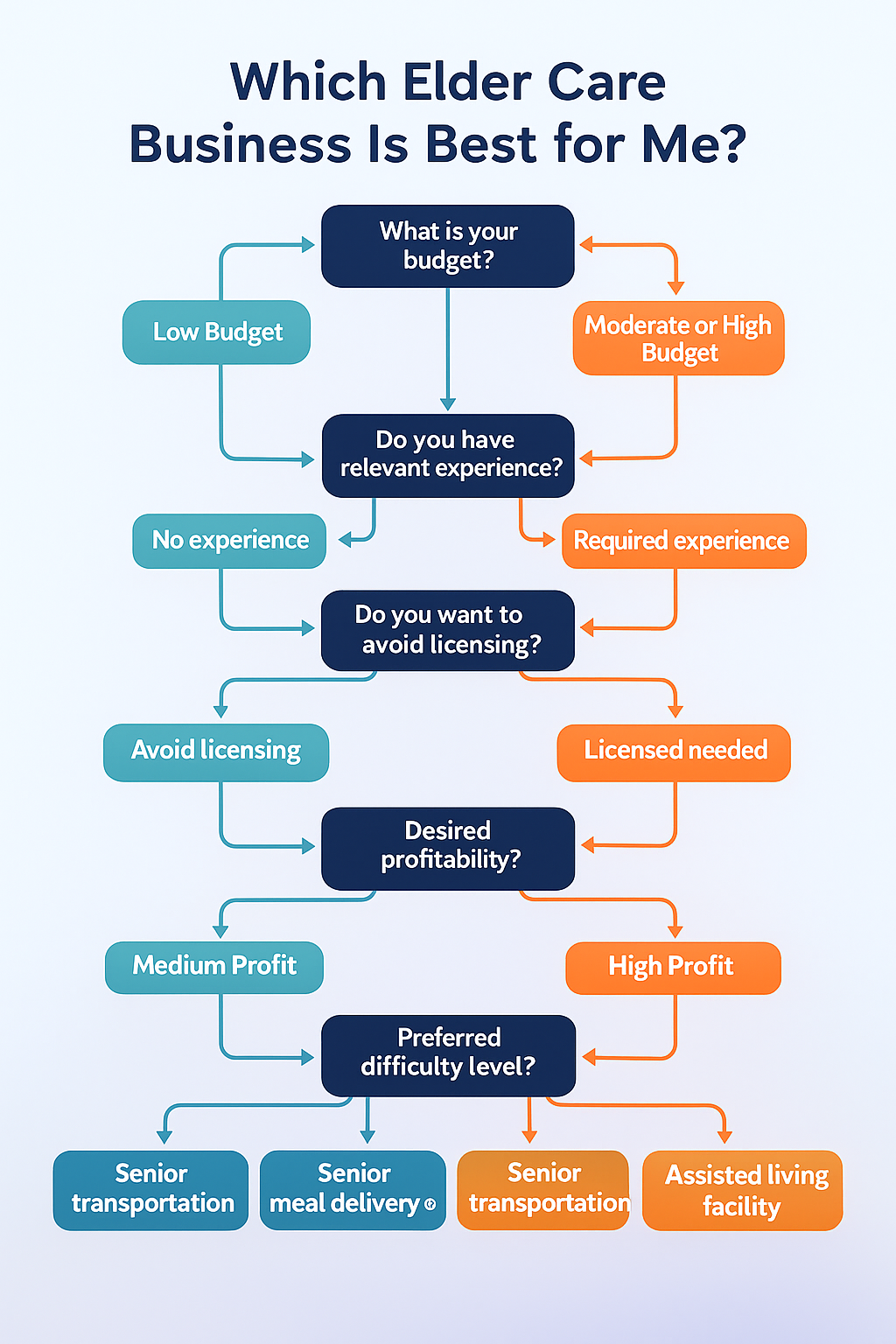
Here is the Elder Care Business Decision Tree that you might find useful:
How to Start an Elder Care Business (Step-by-Step Guide)
Starting an elder care business is one of the most rewarding paths for entrepreneurs, especially as demand grows globally. But success requires thoughtful planning, compliance with regulations, and a deep understanding of seniors’ needs.
Step 1: Research Local Senior Needs
Every successful elder care business starts with understanding what seniors in your area actually struggle with. Senior needs vary from region to region based on health conditions, access to transportation, income levels, and the availability of family caregivers.
How to research your area:
- Check local census data to understand senior population size.
- Visit senior centers, retirement communities, and churches to ask about needs.
- Review Google Maps listings for existing home care agencies.
- Look at online reviews to identify what competitors are doing well or poorly.
- Join community Facebook groups to observe common frustrations.
- Explore local health department reports on aging and chronic disease rates.
You’re looking for patterns, such as:
- Many seniors lack transportation.
- Dementia support is limited.
- Families need respite care.
- Tech help is requested often.
- Meal delivery options are scarce.
This ensures you choose a business idea with real demand, not just potential.
Step 2: Choose Your Elder Care Niche
The senior care market is wide. Choosing a focused, clearly defined niche helps you stand out and operate more efficiently.
Examples of niche directions:
- Non-medical in-home care
- Dementia and memory support
- Senior transportation
- Home modifications
- Senior tech training
- Meal prep and nutrition care
- Senior fitness and mobility training
- Mobile medical care
- Respite services
- Errand and concierge support
- Senior-focused e-commerce
- Mental health counseling
Ask yourself:
- Which niche aligns with your skills?
- What is missing in your local market?
- What can you realistically start with your budget?
- Do you prefer direct interaction with seniors or managing a team?
Choosing the right niche will shape your certifications, legal structure, pricing, and staffing.
Step 3: Understand Legal Requirements
Elder care businesses are regulated differently depending on the service you plan to offer. Ignoring this step can lead to fines, closure, or legal liability.
Common legal requirements include:
- Business registration and licensing
- State-specific home care licensing (if offering personal care or medical support)
- Background checks for caregivers
- CPR and First Aid certification for staff
- Facility permits for adult day care or assisted living
- ADA compliance for senior transportation
- Data protection rules if creating tech products
Tips:
- Visit your local Department of Health or Human Services website.
- Call your state licensing board to clarify what is required.
- Document every legal requirement before investing further.
Step 4: Get Necessary Certifications
Certifications improve credibility, increase hiring potential, and help you secure contracts with families, senior centers, and clinics.
Common certifications include:
- Caregiver training or personal support worker certification
- Certified Nursing Assistant (for medical tasks)
- Alzheimer’s and dementia care certification
- Senior fitness instructor certification
- Professional nutritionist or dietitian license
- CPR and First Aid for all staff
- Business liability insurance training
- HIPAA compliance if dealing with medical data
Choose certifications that match your business niche rather than completing everything at once.
Step 5: Create a Detailed Business Plan
Your business plan does not need to be complicated, but it must be realistic and specific.
Include:
- Your business model (service-based, facility-based, or digital)
- Your local senior needs analysis
- Your niche and differentiation
- Startup cost estimates
- Pricing structure
- Marketing plan
- Staffing strategy
- Profit projections
- Legal and licensing steps
- Risk management plan
- Timeline to launch
A strong business plan helps you stay focused and is essential if you plan to apply for grants, loans, or partnerships.
Step 6: Develop a Pricing Model
Pricing varies based on location, service type, and competition. Your goal is to create rates that are profitable, competitive, and clearly understandable to families.
Common senior care pricing models:
- Hourly rates (20–40 USD/hr for non-medical care)
- Flat monthly packages
- Subscription plans for fitness, tech help, or nutrition
- Per-visit fees (transportation, errands, pet care)
- One-time service fees (home modifications)
- Premium on-call packages (high-value concierge support)
Consider:
- Local competitor pricing
- Your profit margins
- Caregiver wages (if hiring)
- Operational costs
- Insurance and licensing fees
- Demand for specialized services
Transparent, flexible pricing creates trust with families immediately.
Step 7: Register Your Business
Registering your business ensures you operate legally and gain credibility in the senior care industry.
Steps:
- Choose a business name aligned with care, trust, and professionalism
- Register as an LLC or corporation (for liability protection)
- Obtain an EIN number from the IRS
- Register your business with your state and city
- Get a business bank account
- Apply for local permits required in health-related industries
Registration legitimizes your business and lays the foundation for scaling.
Step 8: Get Insurance
Insurance protects you from liability, accidents, and unexpected issues.
Relevant insurance types include:
- General liability insurance
- Professional liability insurance
- Workers’ compensation for caregivers
- Commercial auto insurance (for transportation businesses)
- Cybersecurity insurance (for tech-based elder care businesses)
- Property insurance if you operate from a physical location
Never operate a senior care business without adequate insurance, regardless of niche.
Step 9: Hire and Train Caregivers or Staff
Your team determines your reputation. Families rely heavily on trust when choosing services for their loved ones.
Hiring steps:
- Write clear job descriptions
- Run background checks
- Verify certifications and past experience
- Provide caregiver training and onboarding
- Establish quality-of-care standards
- Create emergency and incident protocols
- Train staff in communication with families
- Offer ongoing education (especially for dementia or mobility care)
Best hires include CNAs, home health aides, caregivers with dementia experience, or companions with strong interpersonal skills.
Step 10: Set Up Your Marketing Strategy
Senior care is highly relationship-based. Marketing should build trust, highlight your values, and show your professionalism.
Effective marketing includes:
- A simple, clean website with clear service descriptions
- Listing your business on Google Business Profile
- Partnering with senior centers
- Posting educational content about elder care
- Joining local Facebook and community groups
- Creating printed brochures for clinics and churches
- Running small ads targeting adult children aged 40–60
- Asking for referrals from families
- Offering a free first consultation
Marketing should position you as caring, reliable, and informed about seniors’ needs.
Step 11: Build Partnerships With Senior Organizations
Partnerships quickly elevate your credibility and bring steady referrals.
Potential partners:
- Local clinics and physicians
- Senior activity centers
- Physical therapy offices
- Churches and community groups
- Real estate agents specializing in downsizing
- Home health agencies
- Hospice teams
- Senior housing communities
- Local government aging services
These partnerships help you tap into existing networks and get a steady flow of clients.
Step 12: Launch With Your First 3–5 Clients
Instead of trying to scale immediately, focus on delivering exceptional service to your first small group of clients. This helps you refine operations, gather testimonials, and prove your business model.
How to find your first clients:
- Referrals from friends and family
- Posting in community groups
- Offering a launch discount
- Partnering with a local clinic or senior center
- Running a small ad with a clear call to action
- Offering a free consultation or first visit
Track everything during these early stages:
- Hours worked
- Client satisfaction
- Service quality
- Profit margins
- Operational bottlenecks
Once you refine your systems, you can confidently expand.
Elder Care Business Startup Timeline Summary Table
| Week | Step | What You Do | Key Outcomes |
|---|---|---|---|
| Week 1 | Research local senior needs | Analyze senior demographics, review competitor gaps, speak with senior centers, study common pain points | Clear understanding of high-demand services in your area |
| Week 2 | Choose your niche | Select the elder care business model based on skills, market demand, and budget | A defined, profitable niche with long-term potential |
| Week 3 | Understand legal requirements | Review state/local regulations, care licensing rules, caregiver background checks, transportation laws, HIPAA rules if applicable | A clear legal roadmap of what’s required before launch |
| Week 4 | Get certifications | Complete caregiver training, First Aid/CPR, dementia training, fitness or nutrition certifications if relevant | Credentials that increase credibility and expand service options |
| Week 5 | Create business plan | Outline services, pricing, startup costs, operations, marketing, staffing, and growth strategy | A full elder care business plan that guides decisions |
| Week 6 | Plan pricing model | Research local competitor rates, define hourly vs package pricing, calculate profit margins | A transparent and competitive pricing system |
| Week 7 | Register business | Set up LLC or corporation, obtain EIN, register licenses and permits, open business bank account | Legally established elder care business |
| Week 8 | Get insurance | Secure liability insurance, worker’s compensation, commercial auto (if needed), cybersecurity insurance for tech models | Full protection against risk and liability |
| Week 9 | Hire staff | Recruit caregivers, verify certifications, create onboarding and quality standards | A reliable team trained to deliver consistent care |
| Week 10 | Build marketing foundation | Launch website, claim Google Business Profile, print brochures, post in community groups, create referral program | Initial visibility and trust-building online and offline |
| Week 11 | Build partnerships | Connect with clinics, therapists, senior centers, churches, real estate agents, and community groups | Trusted partnerships generating referrals |
| Week 12 | Launch with first 3–5 clients | Start service delivery, collect feedback, build testimonials, refine operations | Proven business model ready to scale |
Startup Costs and Licensing Requirements
Starting an elder care business can range from extremely affordable to highly capital-intensive depending on the type of services you want to offer. The senior care industry includes low-cost models like companionship or errands, medium-cost models like senior transportation or home modification, and high-investment opportunities such as assisted living or memory care facilities. Understanding startup costs and licensing requirements is crucial before beginning, especially because regulations vary widely by location.
Licensing affects who you can serve, what services you can offer, and how you must operate. Some elder care business opportunities require little to no licensing, while others involve strict state or federal compliance. Below is a full breakdown to help you understand the financial and regulatory commitments involved.
Startup Cost Categories
Low-Cost (500–3,000)
Examples: companionship services, errands and concierge, tech assistance, pet care, meal prep, senior cleaning, travel planning
These businesses require minimal equipment and are ideal for first-time founders or women entrepreneurs entering the space with limited capital.
Medium-Cost (3,000–25,000)
Examples: senior transportation, fitness coaching, nutritional counseling, home modification services, VR experiences, small e-commerce inventory
These require some training, tools, or vehicle upgrades but allow faster scaling and higher earnings.
High-Cost (25,000–250,000+)
Examples: adult day care centers, home health agencies, mobile medical services
These require significant licensing, compliance, staffing, and physical space investment.
Very High Investment (250,000–2 million+)
Examples: assisted living facilities, memory care facilities
These require real estate, facility licensing, medical oversight, and large-scale staffing.
Licensing Requirements by Business Type
Licensing depends heavily on whether you are offering:
- Medical care
- Personal care assistance
- Facility-based care
- Transportation services
- Food services
- Counseling or therapy
Some states require full home care licensing even for non-medical in-home support. Others allow companionship services with no licensing at all.
General rule:
- Medical services always require licensed clinicians.
- Personal care often requires state-specific home care licensing.
- Non-medical companionship typically requires no license but may require background checks.
- Physical facilities require local zoning approvals and facility-specific licenses.
- Transportation services require ADA compliance and commercial insurance.
- Meal services require food handling permits.
- Counseling requires mental health or social work licensure.
Because elder care involves vulnerable individuals, regulatory compliance is essential for trust and safety.
Typical Licensing Requirements
For Non-Medical Care
- Background checks
- Basic caregiver training
- CPR and First Aid
- Possible state home care registration
- Business liability insurance
For Medical Care (Home Health, Mobile Medical, Hospice)
- Registered nurses or nurse practitioners
- Physician oversight
- Home health agency license
- Specialized medical insurance
- Compliance with healthcare privacy laws
For Facility-Based Care (Assisted Living, Memory Care, Adult Day Care)
- Facility inspection and approval
- Safety and fire compliance
- Staff-to-resident ratio requirements
- Specialized administrative licensing
- Detailed operational policies
For Service-Based Non-Clinical Businesses
- Meal prep: food handler certification
- Transportation: commercial auto insurance, ADA training
- Counseling: mental health licensure
- Financial planning: advisor certification
- Fitness coaching: senior fitness certification
Understanding Difficulty Level
Difficulty is determined by:
- Regulatory complexity
- Number of required certifications
- Staffing needs
- Physical space requirements
- Legal oversight
- Administrative workload
Low-difficulty businesses are easy to start quickly. High-difficulty opportunities require long-term planning, compliance, and substantial capital.
Startup Cost and Licensing Summary Table
| Elder Care Business Type | License Required? | Cost to Start | Difficulty Level |
|---|---|---|---|
| Senior companionship services | Usually no | 200–2,000 | Low |
| Senior errand and concierge services | No | 300–1,500 | Low |
| Senior tech assistance | No | 200–800 | Low |
| Meal prep and grocery assistance | Food handler permit (sometimes) | 500–2,000 | Low |
| Senior cleaning services | No | 300–2,500 | Low |
| Senior pet care assistance | No | 200–1,500 | Low |
| Senior travel planning | Optional travel certification | 500–3,000 | Low |
| Senior fitness coaching | Fitness certification recommended | 800–3,000 | Low–Medium |
| Nutritional counseling | Nutrition license | 1,000–3,000 | Medium |
| Senior-friendly e-commerce | No | 1,000–3,000 | Low |
| Senior transportation business | Transport permit, ADA training | 3,000–25,000 | Medium |
| Senior home modification services | Contractor license | 5,000–50,000 | Medium |
| Senior fitness equipment rental | No | 5,000–25,000 | Medium |
| VR experiences for seniors | No | 3,000–40,000 | Medium |
| Senior financial planning | Financial advisor license | 1,000–10,000 | Medium |
| Senior counseling/mental health | Mental health licensure | 2,000–20,000 | Medium–High |
| Adult day care centers | Facility license | 30,000–250,000 | High |
| In-home non-medical senior care | Sometimes, depends on state | 2,000–15,000 | Medium |
| In-home medical home health | Yes, home health agency license | 50,000–150,000 | High |
| Mobile medical services | Yes, medical provider license | 20,000–150,000 | High |
| Hospice and palliative care | Yes, hospice license | 50,000–200,000 | High |
| Senior mobility equipment rental | No (vendor approval sometimes needed) | 10,000–50,000 | Medium |
| Assisted living facility | Yes, facility license | 250,000–2 million | Very High |
| Memory care facility | Yes, specialized facility license | 300,000–2 million | Very High |
Elder Care Business Profit Margins Explained
Profit margins in the elder care industry vary widely depending on the service type, licensing requirements, staffing needs, and operational complexity. Some elder care business opportunities operate with very lean overhead, while others require intensive staffing and regulatory compliance that affect margins. However, the elder care sector remains one of the most stable and profitable markets due to recurring demand, limited competition in many regions, and long-term client relationships.
This section breaks down profit margins for major elder care business categories so you can understand which options generate the highest returns and why.
What Influences Profit Margins in Elder Care?
Several core factors determine the profitability of any senior care business:
Labor costs
Caregiving is labor-intensive. Businesses that require caregivers, CNAs, nurses, or therapists will have lower margins unless pricing is structured well.
Licensing and compliance
Businesses that must meet strict regulatory requirements incur higher administrative expenses, reducing margins until they scale.
Equipment or facility costs
Transportation vans, medical equipment, home modification tools, and facility rent impact profitability.
Pricing flexibility
Businesses with specialized or premium services can charge more, increasing margins.
Recurring revenue
Models with weekly or monthly recurring clients achieve much higher margins due to predictable income and lower marketing cost per client.
Understanding these factors helps founders choose the right business model and build realistic revenue projections.
High-Margin Elder Care Businesses (30%–60%+ profit margin)
These businesses offer strong earning potential with relatively low overhead and high demand.
In-home non-medical senior care
Profit margin: 35–55 percent
Why: Recurring weekly clients, minimal equipment, high hourly rates relative to caregiver wages.
Senior companionship services
Profit margin: 40–60 percent
Why: Very low costs and strong family demand for ongoing social support.
Senior tech assistance
Profit margin: 50–70 percent
Why: One-person operations with minimal expenses and premium hourly pricing.
Senior errand and concierge services
Profit margin: 40–60 percent
Why: Low overhead and steady weekly tasks.
Nutritional counseling
Profit margin: 40–65 percent
Why: Service-only model with high perceived value.
Senior fitness coaching
Profit margin: 35–60 percent
Why: High hourly session rates and minimal equipment.
Senior-friendly e-commerce (dropshipping or low inventory)
Profit margin: 30–50 percent
Why: Low startup costs and specialized product margins.
These models are ideal for entrepreneurs who want to generate strong income without heavy investment.
Medium-Margin Elder Care Businesses (20%–35%)
These offer excellent potential but involve more resources, equipment, or staffing.
Senior home modification services
Profit margin: 25–40 percent
Why: Skilled labor and materials costs reduce margins, but project size boosts profits.
Senior transportation services
Profit margin: 20–35 percent
Why: Fuel, insurance, and vehicle maintenance impact margins, but recurring appointment routes raise profitability.
Senior cleaning services
Profit margin: 20–40 percent
Why: Labor-intensive but scalable with proper systems.
Senior mobility equipment rentals
Profit margin: 25–35 percent
Why: Equipment purchases create upfront cost, but rentals generate recurring revenue.
VR experiences for seniors
Profit margin: 20–35 percent
Why: Equipment costs offset strong session fees and facility partnerships.
These businesses scale well once systems are in place.
Lower-Margin but High-Revenue Elder Care Businesses (10%–25%)
These require more staff, licensing, and compliance but generate significant total revenue.
Home health agencies (medical)
Profit margin: 15–25 percent
Why: High licensing costs, clinical employees, and insurance requirements.
Mobile medical services
Profit margin: 15–25 percent
Why: Regulatory burden and medical equipment reduce margins, but visits are reimbursable.
Adult day care centers
Profit margin: 10–25 percent
Why: Facility rent, meals, staff salaries, and activity supplies create overhead.
Hospice and palliative care
Profit margin: 12–22 percent
Why: Clinical staff and compliance reduce margins, but long-term contracts increase total revenue.
These models often produce the highest absolute profits due to large operational scale.
Very High-Revenue but Lower-Margin Elder Care Businesses (8%–20%)
These require major capital investment but are among the most financially rewarding in total annual revenue.
Assisted living facilities
Profit margin: 8–20 percent
Why: Staff salaries, property maintenance, medical oversight, and 24/7 operations require significant resources.
Memory care facilities
Profit margin: 10–20 percent
Why: Specialized staffing and facility enhancements increase costs.
Why founders still choose these:
- Extremely stable demand
- High monthly resident fees
- Long-term contracts
- Opportunity to scale to multiple locations
- Strong resale value
Even with lower margins, annual profits can be very high.
Why Recurring Revenue Is the Secret to High Profit Margins
Elder care businesses with recurring weekly clients consistently earn higher margins because:
- Customer acquisition costs are lower
- Revenue becomes predictable
- Staff scheduling is more efficient
- Upselling becomes easier
- Families prefer long-term service relationships
Examples of strong recurring revenue models:
- Weekly companionship care
- Monthly tech assistance support
- Weekly meal prep sessions
- Recurring senior cleaning visits
- Subscription-based fitness or nutrition coaching
- Long-term home care agency clients
Recurring models are ideal for founders seeking stable, scalable income.
Summary Table: Profit Margins by Elder Care Business Type
| Business Type | Typical Profit Margin | Why the Margin Is High or Low |
|---|---|---|
| Senior companionship services | 40–60% | Low overhead, recurring visits |
| Senior tech assistance | 50–70% | No equipment or staff costs |
| Senior errands and concierge | 40–60% | Minimal expenses, high demand |
| Senior fitness coaching | 35–60% | High session rates, low cost |
| Nutritional counseling | 40–65% | High-value knowledge-based service |
| Senior-friendly e-commerce | 30–50% | Strong product margins |
| In-home non-medical senior care | 35–55% | Premium hourly rates |
| Senior home modification services | 25–40% | High project value offsets material costs |
| Senior transportation | 20–35% | Vehicle and fuel reduce margins |
| Senior cleaning services | 20–40% | Labor-intensive but scalable |
| Mobility equipment rentals | 25–35% | Equipment cost offset by recurring rentals |
| VR experiences for seniors | 20–35% | Equipment cost plus session fees |
| Adult day care centers | 10–25% | Facility and staff costs |
| Mobile medical services | 15–25% | Clinical staff and equipment |
| Home health agencies | 15–25% | Regulatory and staff expenses |
| Hospice and palliative care | 12–22% | Clinical care lowers margins |
| Assisted living facilities | 8–20% | High operational costs but strong revenue |
| Memory care facilities | 10–20% | Specialized staffing needs |
Elder Care Business Ideas Pricing Strategies
Pricing is one of the most important decisions you will make when launching or scaling any elder care business. The right pricing model not only determines profitability, but also influences customer trust, perceived value, and long-term retention. Because elder care often involves recurring services, medical sensitivity, or long-term family relationships, setting prices thoughtfully is essential.
Below is a detailed breakdown of proven pricing strategies tailored to the most common elder care business opportunities — including service-based care, transportation, fitness, meal prep, home modification, and facility-based models.
Understand Your Market Before Pricing
Before choosing your pricing structure, evaluate the following:
Local competitor rates
Gather prices from home care agencies, fitness coaches, cleaners, meal services, and transportation providers in your city. Read more about competitors-based pricing.
Senior income levels
Some areas can sustain premium pricing, while others require more budget-friendly options.
Service complexity
More specialized services (memory care, dementia support, home modification) command higher rates.
Care intensity
Light companionship costs less than personal care or mobility support.
Duration and frequency
Services booked regularly (weekly or daily) should include package pricing or subscription options.
Pricing is not guesswork — it’s a strategic process.
Popular Pricing Models in Elder Care
Hourly Pricing
Used by: in-home care, companionship, errands, senior tech help, cleaning services, fitness coaching.
Hourly pricing is simple, predictable, and easy for families to understand.
Ranges by service type:
- companionship: 18–30 USD/hr
- non-medical home care: 22–35 USD/hr
- tech assistance: 25–75 USD/hr
- cleaning: 25–60 USD/hr
- fitness coaching: 40–80 USD/hr
Pros: flexible, easy to track
Cons: income varies week to week unless clients are recurring
Flat-Rate Visit Pricing
Flat-rate pricing is used by: transportation, meal prep, grocery assistance, pet visits.
This model charges one price for each service visit rather than by the hour.
Examples:
- 20–50 USD per transportation trip
- 40–120 USD per meal prep session
- 15–40 USD per pet visit
- 30–70 USD per grocery delivery
Flat-rate pricing works well when tasks are predictable.
Package Pricing (Weekly or Monthly)
Package pricing is great for recurring services such as companionship, errands, cleaning, and fitness coaching.
Examples:
- 8-hour weekly companionship package
- Monthly senior fitness plan
- Weekly meal prep bundle
- Tech support membership
Packages create stable income and reduce last-minute cancellations.
Subscription Pricing
Subscription pricing is growing rapidly in senior services. Works best for:
- tech assistance
- meal prep
- fitness coaching
- nutrition counseling
- caregiving coordination apps
- VR experience subscriptions
Subscriptions increase lifetime value and reduce marketing costs.
Tiered Pricing
Tiered pricing is useful for services with different levels of care intensity.
Example for in-home care:
- Tier 1: companionship only
- Tier 2: personal care + mobility assistance
- Tier 3: specialized dementia care
This helps clients choose based on need and budget.
Premium Pricing
Works for highly specialized or emotionally meaningful services such as:
- dementia care
- mobility planning
- senior travel planning
- nutritional therapy
- tech concierge services
Clients are often willing to pay more for high-value specialized skills.
Pricing Strategies by Elder Care Business Type
Here are the best pricing strategies:
In-Home Senior Care
- Base hourly rate: 22–35 USD/hr
- Higher rate for dementia: +20–40 percent
- Holiday or overnight premium: +30 percent
- Monthly packages recommended for recurring clients
Senior Transportation
- Per-trip pricing: 25–70 USD
- Add-ons: wheelchair assistance, wait time, long-distance rates
- Membership model for recurring medical appointments
Meal Prep and Delivery
- Per-session meal prep: 40–120 USD
- Subscription: 150–500 USD/month
- Add-ons: diabetic-friendly, low sodium, soft diet
Senior Fitness Coaching
- One-on-one sessions: 40–80 USD
- Group classes: 10–25 USD per participant
- Membership: monthly senior wellness plan
Tech Assistance for Seniors
- Hourly sessions: 25–75 USD
- Monthly subscription: 40–150 USD/month
- Premium add-ons: smart home setup, device management
Respite Care
- Hourly: 22–40 USD/hr
- Daily rate: 120–250 USD/day
- Overnight support: premium pricing
Senior Home Modification
- Small jobs: 150–500 USD
- Mid-range: 2,000–10,000 USD
- Full remodels: 15,000–40,000+
- Bundle assessments + first installation for higher conversions
Adult Day Care
- Daily rates: 65–120 USD per participant
- Add-ons: meals, transportation, dementia activities
- Monthly commitments reduce churn
Mobile Medical Services
- Per visit: 75–250 USD
- Package: monthly chronic-condition monitoring
- Insurance reimbursement may apply
Pricing Psychology for Elder Care Businesses
Senior services are emotional purchases. Families want reliability, trust, and peace of mind.
Use these psychological pricing principles:
Anchoring
Present a premium package first to make base packages look more affordable.
Transparency
Itemize what is included in each service to show value clearly.
Value stacking
Bundle multiple services (companionship + errands + meal prep) for high subscription revenue.
Loss aversion
Highlight the risks of delaying help, such as fall accidents or health decline.
Emotional reassurance
Explain how your service reduces family stress, worry, or caregiver burnout.
Families are willing to pay more for emotional value, not just tasks.
Tips for Setting Highly Profitable Pricing
- Don’t compete solely on low prices; compete on trust and reliability.
- Offer smaller entry-level packages to reduce hesitation.
- Introduce premium services for clients willing to pay more for specialization.
- Reevaluate pricing every 6–12 months based on demand and costs.
- Charge extra for last-minute bookings, holidays, or heavy-labor tasks.
- Add memberships or subscriptions to stabilize income.
- Track your hourly profit margin per client, not just revenue.
Well-structured pricing can double your profitability without increasing workload.
Funding Options and Grants for Senior Care Businesses
Launching an elder care business can require anywhere from a few hundred dollars to several hundred thousand, depending on your niche. Fortunately, senior care is considered a high-impact, community-focused industry, which opens the door to special funding programs, government support, and grants that other industries don’t qualify for. This section gives you a full, detailed overview of the best ways to fund your senior care startup — whether you’re launching a low-cost service business or a large-scale facility.
Self-Funding and Low-Cost Bootstrapping
Many elder care businesses can be started with very little capital, especially non-medical services. Bootstrapping is ideal if you want full control without taking on debt.
Best for low-cost niches such as:
- senior companionship
- errands and concierge services
- tech assistance
- cleaning services
- meal prep
- pet care
- fitness coaching
- senior-friendly e-commerce
Tips for self-funding:
- Start with part-time service delivery while keeping another income source
- Offer pre-launch discounts to generate early cash flow
- Use free tools (Google Business Profile, Canva, Facebook groups)
- Begin as a solo operator before hiring staff
Bootstrapping works especially well when you aim to start quickly and scale gradually.
Small Business Loans
Senior care qualifies for a variety of traditional loans due to stable, long-term demand.
Common loan sources include:
- local banks
- credit unions
- SBA-backed loans (in the U.S.)
- women-focused lending programs
- community development financial institutions (CDFIs)
Loan sizes vary from 5,000 to 250,000+, depending on your business model and credit history.
Ideal for:
- senior transportation businesses
- home modification services
- adult day care centers
- mobile medical services
- e-commerce inventory
- medium-sized home care agencies
A strong business plan and financial projections are necessary for approval.
SBA Loans (United States)
The Small Business Administration offers some of the best financing options for elder care businesses.
Types of SBA loans that apply:
- SBA 7(a) Loan: up to 5 million USD for most elder care businesses
- SBA Microloan: up to 50,000 USD for small service-based startups
- SBA 504 Loan: property and facility financing (assisted living, adult day care)
Why elder care qualifies easily:
- essential community service
- long-term demand
- stability compared to other industries
These loans often have lower interest rates and longer repayment terms.
Grants for Women-Owned Senior Care Businesses
Since elder care is considered a social-impact sector, many organizations offer grants specifically to women founders.
Popular grant sources for women-owned businesses:
- Amber Grant for Women
- Cartier Women’s Initiative
- The Halstead Grant (for women entrepreneurs)
- SoGal Foundation Black Founder Startup Grant
- Tory Burch Foundation Fellows Program
- Local women’s business development centers
- State-funded women entrepreneur grants
- AARP social entrepreneurship funding programs
- Grants from local healthcare foundations and nonprofits
Grant amount ranges:
- 2,000 to 100,000 depending on the program
These grants do not need to be repaid, making them ideal for new founders.
Healthcare and Social Impact Grants
Many government agencies and nonprofit organizations fund elder care startups because they help vulnerable communities.
Potential funding sources include:
- Department of Health and Human Services
- Local aging and disability service offices
- Medicaid innovation grants (in some states)
- Community health improvement grants
- Senior wellness and fall-prevention grants
- Grants for dementia care programs
- Cultural or community organization funding
These grants support programs such as:
- adult day care
- dementia support
- caregiver training
- nutrition and wellness programs
- fall-prevention workshops
- local senior transportation pilots
Many of these programs prioritize minority-, women-, or community-owned businesses.
Private Investors and Angel Funding
Private investors are increasingly interested in elder care because it is one of the fastest-growing markets due to the aging population.
Types of investors who might fund elder care:
- impact investment funds
- physician groups
- medical organizations
- senior living developers
- angel investors specializing in healthcare or technology
- private equity for assisted living and home care agencies
These investors look for:
- scalable business models
- technology-driven elder care solutions
- strong leadership and experience
- recurring revenue potential
- clear market demand
Ideal for high-growth niches like:
- senior app development
- VR therapy and cognitive stimulation
- mobile medical services
- home care franchises
- dementia care programs
Crowdfunding
Crowdfunding offers a low-risk way to launch a senior care business while building community support.
Where to crowdfund:
- Kickstarter
- GoFundMe
- Indiegogo
- Kiva (microloans with 0 percent interest)
- Local crowdfunding platforms
Best for:
- senior transportation businesses
- community-focused meal delivery
- senior fitness or wellness programs
- tech-enabled elder care tools
Crowdfunding is especially effective when your business addresses a clear community problem.
Partnerships and Sponsorships
Community partnerships can provide resources, funding, or free support.
Potential partners:
- churches
- senior centers
- medical clinics
- physical therapy offices
- nonprofit organizations
- local companies looking for corporate social responsibility initiatives
Some partnerships offer financial assistance or shared funding for events, workshops, or pilot programs.
Franchise Financing Programs
Senior care franchises often offer financing options for new owners, including reduced fees, payment plans, or connections to lenders.
Senior care franchises with financing support may include:
- non-medical home care
- senior transportation
- dementia support programs
- wellness or mobility coaching
- meal delivery
- home modification services
Franchises cost more upfront, but they provide:
- training
- branding
- operational systems
- proven profitability
- marketing materials
This reduces risk for first-time founders.
Funding for Large Elder Care Facilities
Assisted living facilities, memory care units, and adult day care centers require significant investment.
Funding may come from:
- SBA 504 loans
- commercial real estate loans
- healthcare investors
- angel groups
- private equity
- state-funded facility development grants
- property development partnerships
- real estate investment partners
These models often require complex financial structures but produce long-term, high-revenue operations.
Final Advice on Funding Your Elder Care Business
- Start small if you have limited capital; scale later when cash flow stabilizes.
- Don’t pursue an expensive licensing-heavy model without understanding regulations.
- Grant programs for women can significantly reduce startup costs.
- Loans are ideal for mid-level service businesses with predictable revenue.
- Facilities and medical services require professional investors or real estate lending.
- Build partnerships early; they help establish trust and reduce marketing costs.
Funding should match your business model, goals, and risk tolerance—not the other way around.
Marketing Strategies for Senior Care Businesses
Marketing a senior care business requires a unique approach rooted in trust, reputation, credibility, and community presence. Unlike traditional service businesses, elder care depends heavily on relationships, personal referrals, and local visibility. Families want to know they can trust you with their loved ones, which means your marketing must highlight reliability, compassion, and professionalism.
Below is a full, expanded breakdown of the most effective marketing strategies for elder care businesses, especially in-home care, transportation, fitness, companionship, and other local service niches.
Build a Strong Referral Network
Referrals are the single most powerful marketing channel in elder care. Families trust recommendations from people who already understand the challenges of senior care.
Who to ask for referrals:
- existing clients
- past clients
- adult children of clients
- caregivers you employ
- medical professionals
- neighbors and community members
- senior living facilities with overflow demand
How to encourage referrals:
- After a positive service experience, ask if they know anyone else in need
- Provide referral cards or digital referral links
- Offer small thank-you gifts or discounts
- Share stories and testimonials (with permission)
Referral-based marketing grows quickly when your reputation is strong and your service quality is consistent.
Build Partnerships with Local Organizations
Partnerships help you reach seniors who need help but may not know where to look. Elder care is deeply community-centric, so building strategic alliances can dramatically accelerate growth.
Potential partners include:
- clinics and medical practices
- physical therapists
- senior centers
- churches and faith-based groups
- senior living communities
- pharmacies
- local libraries
- real estate agents who specialize in downsizing
- funeral homes (for grief-related support services)
- physical therapy offices
- city aging departments
- meal programs for seniors
How to approach partners:
- Provide free informational brochures
- Offer to host workshops or safety seminars
- Create a simple referral program
- Ask partners what gaps they see in the community
- Offer free first sessions or consultations
Partnerships build credibility quickly and help your business integrate into the local senior care ecosystem.
Attend and Participate in Community Events
Seniors and their families rely on personal interaction to build trust. Being visible at local events is one of the fastest ways to establish authority.
Events to attend:
- senior fairs
- health and wellness expos
- community days
- church events
- caregiver support group meetings
- local government aging council gatherings
- library workshops
- charity events focused on seniors
- open houses at senior living facilities
Ways to make events effective:
- hand out simple brochures with clear services
- offer free educational workshops (fall prevention, senior tech help)
- create a giveaway for attendees
- provide free blood pressure checks if medically licensed
- host Q&A sessions with caregivers or nurses
- engage families and caregivers with empathy
Community involvement helps you connect directly with families and build a trustworthy presence.
Optimize and Maintain Your Google Business Profile
Your Google Business Profile (GBP) is essential for local visibility. Most families search “senior care near me,” “home care for seniors,” or “help for my elderly parent,” meaning your GBP is often the first place they look.
How to Create a Google Business Profile (For Local Care Services)
Setting up a Google Business Profile is one of the simplest and most effective ways to get clients for any local elder care service. Families often search online for “senior care near me,” “caregiver for elderly parent,” or “[city] home care,” and your Google Business Profile is usually the first thing they see. Here is a clear, step-by-step guide tailored specifically for elder care businesses.
Step 1: Go to the Google Business Website
Visit the Google Business Profile setup page by searching “Google Business Profile” or going to the Google Business manager page.
Click “Manage Now” to begin creating your listing.
Step 2: Enter Your Business Name
Use the exact name you plan to present to clients.
Examples:
- Comfort Steps Senior Care
- Sunrise Home Support
- Tech Help for Seniors [City]
Avoid adding keywords or city names unless they’re part of your real business name. Consistency helps with ranking.
Step 3: Choose the Right Business Category
This is one of the most important steps for senior care SEO.
Best categories for elder care businesses include:
- Home Health Care Service
- Elder Care Services
- Senior Citizen Center
- Non-Medical Home Care
- Transportation Service
- Personal Support Worker
- Assisted Living Facility
- Adult Day Care Center
- Meal Delivery Service
- Fitness Trainer
Select the category that best matches your main service.
Step 4: Add Your Service Area
For elder care services you usually go to the client’s home, so select “Service Area Business.”
Enter:
- your city
- nearby suburbs
- neighborhoods within your radius
Keep it realistic. Too large of a service area can weaken your local ranking.
Step 5: Add Your Business Address or Home Address (Optional)
Many non-medical elder care entrepreneurs operate from home.
You can:
- hide your home address (recommended)
- still show your service area
- still appear in “near me” searches
If you do have an office, list the full address.
Step 6: Add Contact Information
Include:
- phone number
- website (if available; you can add it later)
Tip: Use a dedicated business phone number to appear more professional.
Step 7: Add Services and Descriptions
Google allows you to list specific services. Add every service you offer, such as:
- companionship visits
- light housekeeping
- dementia care support
- meal prep
- senior transportation
- fall-prevention coaching
- grocery assistance
- respite care
Then create a short business description (750 characters maximum) explaining your services, service area, and why families trust you.
Step 8: Add Photos (Very Important for Care Businesses)
Photos dramatically increase client trust.
Upload:
- a friendly headshot (or team photo)
- your logo
- images of your service setup (car, equipment, meal prep, activities)
- images of you assisting seniors (no faces unless you have permission)
Businesses with photos receive more calls and clicks.
Step 9: Verify Your Business
Google usually verifies by:
- postcard by mail
- phone verification
- email verification
Follow the steps provided. Verification unlocks visibility in Google Maps.
Step 10: Optimize Your Profile Weekly
Google rewards active businesses.
Do weekly updates such as:
- uploading new photos
- posting short updates about services
- adding FAQs
- responding to reviews
- adjusting service areas
This helps you rank high in searches like “senior care near me,” “home care [city],” and “caregiver for elderly parent.”
Step 11: Collect Reviews From Clients and Families
Reviews are essential in elder care because families need reassurance.
Ask for reviews:
- after a successful week of service
- after first-time appointments
- after long-term care relationships
- via SMS or email links
Respond to every review to show reliability and engagement.
Step 12: Track Insights
Google provides metrics on:
- how many people found you
- what keywords they used
- how many called you directly from your profile
This helps you understand which services and neighborhoods generate the most demand.
How to optimize your profile
- Use the correct business category (“Home Health Care,” “Senior Care,” “Elderly Services”)
- Add accurate service descriptions
- Include high-quality photos of your team, office, or service environment
- Update hours and contact details
- Add your service area
- Use keywords naturally in your business description
- Enable messaging so families can reach you easily
GBP is your most important local marketing asset, especially for non-medical home care and senior services.
How to improve rankings:
- post weekly updates or photos
- respond to every review
- add new services to the Services tab
- encourage clients to leave reviews
- improve NAP (name, address, phone) consistency across directories
A well-maintained GBP can bring 50–80 percent of your inbound inquiries.
Local SEO for Senior Care Businesses
Local SEO ensures your business appears high in Google search results when families in your city look for help.
Core Local SEO strategies include:
- Creating a service page for every elder care niche you offer
- Adding your location to page titles and descriptions
- Embedding a Google map on your contact page
- Listing your business in local directories like Yelp, Bing, Care.com, AgingCare, and local chambers of commerce
- Building backlinks from local partners, clinics, and community organizations
- Publishing educational content targeting local search terms
Examples: “senior fitness programs in [City],” “in-home care for dementia in [City],” “transportation for seniors in [City]” - Updating your website regularly with SEO-optimized blog posts
- Adding testimonials and case studies
Local SEO is essential because elder care is 99 percent local — families choose providers within 5–20 miles of their home.
Use Content Marketing to Build Trust
Families researching elder care often want guidance before selecting a service provider.
Effective content includes:
- guides about aging at home
- safety tips for seniors
- caregiver burnout resources
- dementia care tips
- nutrition and mobility advice for seniors
- how to choose a home care agency
Publishing this content positions you as an expert, builds search traffic, and reassures families that you understand their needs.
Social Media for Senior Care
Social media is most effective for reaching adult children (ages 40–65), who usually make decisions about elder care.
Best platforms:
- YouTube
- Nextdoor
- Local community groups
Content ideas:
- caregiver tips
- behind-the-scenes photos
- senior success stories
- team introduction posts
- fall-prevention exercises
- safety checklists
- holiday reminders for families
Social media helps humanize your brand and build emotional trust.
Build a Strong Reputation With Reviews
Reviews are critical for converting clients. Families will not choose a senior care provider with no reviews or poor ratings.
Ask for reviews:
- after a successful service
- during long-term care relationships
- after a meal prep or transportation visit
- via email or SMS follow-ups
Respond to all reviews professionally. A single 5-star review can dramatically increase conversion rates.
Create Simple, Trust-Building Marketing Materials
Families prefer clarity over complexity. Your marketing materials should clearly explain:
- who you help
- what you offer
- how to contact you
- pricing or packages
- why you are trustworthy
Useful materials include:
- brochures
- one-page service lists
- printed business cards
- caregiver introduction booklets
- flyers for clinics or senior activity centers
Simple materials build confidence and professionalism.
Offer Free Workshops or Community Classes
Workshops position you as a specialist and draw in families who may later become clients.
Effective workshop topics:
- fall prevention
- technology for seniors
- dementia communication strategies
- nutrition for older adults
- scams and fraud prevention
- fitness for mobility and balance
- caregiver stress management
Workshops generate awareness, trust, and referrals.
Run Small Local Ads
Local ads can bring rapid visibility when combined with a strong Google Business Profile.
Where to run ads:
- Google Local Services Ads (important for home care)
- Facebook ads targeting adults age 40–75
- Nextdoor sponsored posts
- Local publications
Ads are most effective when offering free consultations or assessments.
Final Marketing Strategy Tips
- Focus heavily on trust-building instead of aggressive selling
- Prioritize referrals and partnerships over expensive ads
- Keep your Google Business Profile active weekly
- Use local SEO to boost organic visibility
- Create content that solves real problems for families
- Attend community events consistently
- Collect reviews from satisfied clients
- Build connections with clinics, therapists, and senior centers
Marketing for elder care is not about loud promotion — it’s about becoming the trusted, compassionate choice in your community.
Final Marketing Checklist for Senior Care Businesses
Build Your Foundation
✔ Create a clear service list with pricing
✔ Write a simple mission statement focusing on compassion and reliability
✔ Set up a professional website with service pages and contact information
✔ Create and verify your Google Business Profile
✔ Add accurate service areas, photos, descriptions, and hours
✔ Register your business on key directories (AgingCare, Care.com, Yelp, local listings)
Optimize Your Local SEO
✔ Add your city and service keywords to your homepage and service pages
✔ Embed a Google map on the contact page
✔ Make separate pages for each service you offer
✔ Add testimonials and success stories to boost trust
✔ Build backlinks from local partners and community organizations
Build Relationships and Partnerships
✔ Introduce your services to clinics, senior centers, churches, and therapists
✔ Bring printed brochures and business cards to local offices
✔ Offer free first consultations to partnered organizations
✔ Create referral relationships with home health agencies and PT clinics
✔ Join local business groups or chambers of commerce
Establish a Referral Engine
✔ Ask every satisfied client for referrals
✔ Send thank-you notes to families who recommend you
✔ Offer small referral incentives (optional)
✔ Collect testimonials and reviews consistently
✔ Train staff to ask for feedback after each service
Be Active in Your Community
✔ Attend senior expos, health fairs, and local events
✔ Host free educational workshops (fall prevention, dementia tips, tech help)
✔ Volunteer at small community activities a few times per year
✔ Provide safety checklists and printed guides at events
✔ Engage with family caregivers in community groups
Strengthen Your Online Presence
✔ Post weekly on Facebook, Instagram, Nextdoor, or YouTube
✔ Share caregiver tips, safety reminders, mobility exercises
✔ Post behind-the-scenes content to increase trust
✔ Create simple videos explaining your services
✔ Respond promptly to all messages and comments
Use Targeted Advertising
✔ Run Google Local Services Ads if available in your area
✔ Use Facebook ads targeting adults aged 40–75
✔ Promote free consultations or safety assessments
✔ Track results to adjust budgets and messaging
Keep Your Brand Human
✔ Share your story and why you care about elder care
✔ Highlight your team members
✔ Show real seniors (with permission) enjoying activities or receiving help
✔ Communicate warmly and clearly in all materials
Measure and Improve
✔ Track calls, inquiries, and new clients weekly
✔ Review which marketing channels bring the best clients
✔ Adjust pricing, promotions, or messaging every quarter
✔ Update your website and Google Business Profile monthly
✔ Maintain consistent service quality to strengthen word-of-mouth
Senior Care Businesses – Marketing Channels Summary Table
| Marketing Channel | What It Is | Cost Level | Best For | Why It Works |
|---|---|---|---|---|
| Referrals | Word-of-mouth from clients and families | Free–Low | All elder care businesses | Builds trust quickly, highest-quality leads |
| Partnerships | Collaboration with clinics, senior centers, churches, PT offices | Free–Low | In-home care, fitness, transportation, meal prep | Trusted community sources send steady referrals |
| Community Events | Senior fairs, health expos, workshops, local gatherings | Low–Medium | Home care, fitness, mental health, tech help | Face-to-face contact builds credibility |
| Google Business Profile | Free listing on Google search and maps | Free | All local service businesses | Brings organic traffic from local families |
| Local SEO | Website optimization for local search terms | Low–Medium | Home care, transportation, meal prep | Helps you appear in “near me” searches |
| Social Media | Facebook, Instagram, Nextdoor posting | Free–Low | Tech help, companionship, fitness, e-commerce | Reaches adult children who make decisions |
| Content Marketing | Blog posts, guides, safety tips, caregiver advice | Free–Medium | All niches | Establishes authority and builds organic traffic |
| Reviews and Testimonials | Google, Facebook, Yelp, directory reviews | Free | Home care, transportation, cleaning | High trust factor for families comparing providers |
| Printed Materials | Flyers, brochures, cards for clinics or centers | Low | Senior centers, hospitals, churches | Seniors and caregivers respond well to tangible materials |
| Workshops and Classes | Fall prevention, tech training, nutrition, dementia communication | Free–Low | Fitness, tech help, nutrition, memory care | Positions you as an expert and attracts caregivers |
| Local Ads | Google Local Services, Facebook ads, Nextdoor ads | Low–Medium | Home care, transportation, specialized services | Reaches families actively searching for help |
| Directory Listings | AgingCare, Care.com, Yelp, local directories | Free–Low | In-home care and service businesses | Improves visibility and helps SEO |
| Email Marketing | Follow-ups, newsletters, caregiver tips | Free–Low | Businesses with recurring clients | Builds long-term relationships and repeat bookings |
Beyond financial gains, elder care businesses offer the chance to make a meaningful impact on seniors’ lives. Providing care, companionship, and support can be deeply fulfilling while meeting a growing societal need.
By exploring these elder care business opportunities and following the steps outlined, you can start a business that makes a difference while building a sustainable future. Whether you’re passionate about healthcare, technology, or financial planning, there’s a place for you in this rewarding industry.
Market Demand by Service
Not all elder care services grow at the same speed. Some are already widely used and highly competitive, while others are still emerging but growing fast. Understanding demand by service type helps you choose an elder care business idea that fits both your skills and the long-term market.
Below is a breakdown of current and projected demand for home care, transportation, adult day care, dementia care, meal delivery, and senior fitness.
Home Care: The Strongest and Steadiest Demand
Home care continues to be the core of the elder care industry. Globally, most older adults say they want to age in place rather than move into facilities, which drives long-term demand for in-home support, companionship, personal care, and medical home health.
Key demand drivers:
- aging population and longer life expectancy
- more seniors living alone or as couples without extended family nearby
- pressure on family caregivers who also work full-time
- rising healthcare costs pushing care away from hospitals and into homes
Global home healthcare and home care markets are projected to keep growing strongly through the 2020s as health systems shift toward community and home-based care. This makes home care one of the safest and most in-demand elder care business opportunities over the next 10–20 years.
Bottom line:
Demand for home care is high now and is expected to grow steadily. It is the safest option if you want ongoing demand, recurring clients, and a broad service scope.
Senior Transportation: Under-Served but Highly Needed
Transportation is one of the most under-served needs for older adults. Many seniors stop driving due to vision, mobility, or cognitive changes, but still need to get to medical appointments, grocery stores, social events, and therapy.
Key demand drivers:
- seniors living in suburbs or rural areas without good public transport
- frequent medical visits for chronic conditions
- safety concerns about seniors driving themselves
- desire to stay socially active and independent
Hospitals and clinics often struggle with missed appointments because seniors cannot get there. That creates consistent demand for reliable, senior-friendly transportation providers.
Bottom line:
Senior transportation demand is very high in most regions, but the market is still fragmented. It is ideal if you have a vehicle and want a practical, lower-complexity elder care business.
Adult Day Care: Growing as Families Need Daytime Support
Adult day care fills an important gap between home care and full residential care. It helps families who can care for their loved one in the mornings and evenings but need professional support, supervision, and activities during working hours.
Key demand drivers:
- rising caregiver burnout
- more women and adult children in full-time jobs
- seniors needing structure, social interaction, and supervision
- cost advantages compared to assisted living or full-time home care
Adult day care demand is growing in cities and suburbs where families look for safe, structured environments with activities, meals, and socialization. It is especially effective for seniors with mild to moderate cognitive decline who are still mobile.
Bottom line:
Demand for adult day care is rising but still less saturated than home care. It requires more capital and licensing, but can be very strong in communities with many working caregivers.
Dementia and Memory Care: One of the Fastest Growing Needs
Dementia and Alzheimer’s disease are increasing worldwide as people live longer. This creates intense demand for both specialized home care and dedicated memory care programs.
Key demand drivers:
- aging population and longer lifespans
- growing rates of cognitive impairment and dementia diagnoses
- high emotional and physical toll on family caregivers
- lack of specialized dementia training in general care services
Families often struggle to handle dementia symptoms alone and look specifically for providers who understand memory loss, behavior changes, and safety needs. This makes dementia and memory care one of the most in-demand and premium elder care services.
Bottom line:
Memory care demand is very high and rising quickly. It is ideal for founders willing to invest in specialized training and who are comfortable with complex care situations.
Meal Delivery and Nutrition Support: Rising but Still Fragmented
Meal delivery for seniors is a growing niche, especially post-pandemic, as more older adults rely on food brought to their homes. While general food delivery has exploded, seniors often need meals tailored to health conditions like diabetes, heart disease, or chewing and swallowing issues.
Key demand drivers:
- mobility limitations that make shopping and cooking difficult
- chronic disease management that requires diet control
- family members worrying about whether seniors are eating properly
- lack of senior-specific options on mainstream food delivery platforms
This service is often under-served at a local level. Many cities have one or two senior meal programs, but personalized, health-oriented meal prep and delivery remains a gap.
Bottom line:
Demand is moderate to high and growing. It is especially promising when combined with companionship, home care, or nutrition counseling as part of a broader wellness offer.
Senior Fitness and Mobility: Emerging but High-Potential
Senior fitness is one of the newer, fast-growing segments. While older adults have always needed mobility support, there is increasing awareness that strength, balance, and movement can dramatically reduce falls, hospitalizations, and loss of independence.
Key demand drivers:
- growing interest in active aging and longevity
- more doctors recommending exercise instead of only medication
- desire to prevent falls and maintain independence
- retired adults having more time and motivation for fitness
Senior fitness programs, fall-prevention training, and mobility coaching are still under-developed in many markets. There is strong opportunity for trainers, physical therapists, and wellness professionals who can package safe, senior-specific programs.
Bottom line:
Demand is rising quickly and will likely keep growing as awareness increases. It is ideal if you have a health, fitness, or rehab background and want a prevention-focused elder care business.
Comparing Demand Across Services
If we compare these six services side by side:
- Home care has the broadest and most stable demand across all regions.
- Dementia and memory care has the fastest growing need and highest emotional urgency.
- Transportation is highly needed but often under-served, especially outside city centers.
- Adult day care demand grows where there are many working caregivers and limited daytime support.
- Meal delivery demand increases in areas with older adults living alone and limited family support.
- Senior fitness demand is rising and likely to accelerate as more seniors want active, independent lifestyles.
For many founders, the strongest opportunities come from combining two or more high-demand areas, such as home care plus transportation, or companionship plus meal prep and fitness. That way you meet multiple needs for the same senior and increase your revenue per client while delivering more value.
Elder Care Business Opportunities: FAQ
Which elder care business is most profitable?
The most profitable elder care business models are those with recurring revenue, specialized skills, or long-term client contracts. In 2025, the highest-profit opportunities include in-home senior care services, memory care businesses, assisted living facilities, mobile medical services, and senior home modification services. These models benefit from rising demand, higher pricing flexibility, and strong margins.
What is the easiest elder care business to start?
The easiest elder care businesses to start are those with low licensing requirements, simple equipment needs, and minimal upfront capital. These include senior companionship services, errand and concierge support, tech assistance for seniors, pet care assistance, senior cleaning services, meal prep help, and travel planning for seniors. Most of these can be launched with under 500–3,000 USD and require no medical certifications.
Do I need medical certifications to start an elder care business?
You only need medical certifications if you want to offer medical care, personal care, or clinical services. Non-medical elder care businesses such as companionship, errands, meal prep, transportation, cleaning, senior tech help, and fitness coaching typically require no medical license. However, medical services like home health, hospice, memory care, and mobile medical care require licensed nurses, caregivers, or clinical staff.
How much money do I need to start a home care agency?
A typical non-medical home care agency can be started for 2,000–15,000 USD depending on licensing, insurance, training, and staffing. A medical home health agency requires 50,000–150,000 USD for clinical licensing, compliance, and hiring nurses. Many founders start with non-medical care first and expand later into medical or specialty services.
Is senior care still in demand in 2025?
Yes, demand is at an all-time high and rising. According to global aging trends, the number of adults aged 60+ will reach over 2.1 billion by 2050. In the U.S., AARP reports that 10,000 people turn 65 every day. Caregiver shortages also continue to grow, creating more opportunity for new senior care businesses. Home care, dementia support, transportation, wellness, tech help, and meal assistance are especially in high demand.
What certifications do I need for elder care?
Certifications depend on your niche. Non-medical services typically require little more than CPR/First Aid and background checks. Personal care and home health services may require home care licensing or caregiver certifications. Medical services require licensed nurses or clinical professionals. Counseling, nutrition, and fitness require specialty certifications.
Can I start an elder care business with no experience?
Yes. Many low-cost elder care business ideas require no prior experience or medical background. Companionship, tech support, errands, cleaning, fitness coaching, and meal prep can be learned quickly through training programs or online courses. For more advanced services like memory care or home health, experience and certifications are required.
Is elder care recession-proof?
Yes. Senior care remains stable regardless of the economy because older adults always need support. Aging, chronic illness, mobility decline, and caregiver shortages continue whether the market rises or falls. This makes elder care one of the most recession-resistant industries for new entrepreneurs.
Do I need a facility to start an elder care business?
No. Most elder care businesses can operate without a physical location. In-home care, errand support, senior fitness, tech assistance, and meal prep can all be delivered directly in seniors’ homes. Facility-based businesses like assisted living, adult day care, or memory care require significant investment and regulatory approval.
How do I find clients for senior care services?
The best ways to find clients include building partnerships with clinics and senior centers, maintaining a strong Google Business Profile, joining local community events, asking for referrals, using local SEO on your website, connecting with churches and community groups, and running small local ads targeting adult children caring for aging parents.
What are the fastest-growing senior care services in 2025?
The fastest-growing niches include in-home senior care, dementia and memory support, senior mobility and fall-prevention services, transportation for medical appointments, in-home meal prep, senior fitness coaching, senior tech assistance, home modification services, mobile medical care, and digital elder care tools such as apps or VR solutions.
Can I run a senior care business part-time?
Yes. Many low-cost elder care business ideas can be started part-time, including companionship, errands, tech help, fitness coaching, pet care, and meal prep. This is an ideal path for new founders testing demand before expanding to full-time operations.
Do I need a staff to start an elder care business?
Not always. Many elder care businesses can start as solo operations, especially companionship, cleaning, errands, tech assistance, nutrition counseling, and fitness coaching. Businesses requiring staffing include home care agencies, transportation fleets, adult day care centers, and facility-based models.
Can I start a senior home care business with no money?
Yes, you can start certain types of senior care businesses with very little money, especially companionship, errands, tech help, and meal prep services. Many founders begin by offering services part-time, building a small client base through referrals and free marketing channels like Google Business Profile and community groups. However, if you want to start a licensed non-medical home care agency or medical home health business, you will need funding for licensing, insurance, training, and staff.
Do I need a certificate for elder care business?
It depends on the services you offer. Companionship, errands, tech help, meal prep, and housekeeping typically require no formal certificate. Services that involve personal care, medical assistance, nutrition counseling, fitness coaching, or mental health support require certifications or state-specific licenses. For example, personal care aides need caregiver training in many states, fitness coaches need senior fitness certifications, and nutrition counselors need dietitian credentials. Always check your local regulations to understand what applies to your niche.
What elder care services are in highest demand?
The highest-demand senior care services in 2025 include in-home senior care, dementia and memory support, transportation for medical appointments, fall-prevention and mobility support, meal prep and nutrition coaching, senior tech assistance, chronic condition monitoring, and home modification for aging in place. Demand is especially strong for services that allow seniors to remain safely at home and reduce reliance on family caregivers.
How do I choose the right elder care business niche?
Choose a niche based on your budget, skills, comfort level with caregiving, and the needs of your local senior population. If you prefer low-lift businesses, tech help, companionship, errands, or meal prep are ideal. If you have clinical experience, memory care, home health, or mobile medical services may be a better fit. Always research local demand before committing.
Can I run a senior care business from home?
Yes. Many elder care businesses can be operated completely from home, including companionship services, meal prep, tech assistance, fitness coaching, and senior-friendly e-commerce. Only facility-based services like assisted living, adult day care, or certain medical operations require a physical location.
How long does it take to start an elder care business?
Low-cost, non-medical services can be launched in 1–4 weeks. Licensed non-medical home care agencies typically take 1–3 months depending on state rules. Medical home health agencies may take 3–9 months due to licensing, inspections, and staffing requirements. Facility-based businesses can take 6–24 months to fully open.
What age group uses senior care services the most?
Most paid senior care services are used by adults aged 75 and older, especially those living alone or managing chronic conditions. However, demand is increasing among adults aged 65–74, especially for fitness coaching, mobility support, tech help, and meal prep services.
What skills do I need to run a senior care business?
Key skills include communication, empathy, basic caregiving knowledge, scheduling, problem-solving, and reliability. For more advanced niches, skills may include dementia care techniques, fitness training, nutrition knowledge, or clinical experience. Business management, marketing, and customer service skills also make a significant difference.
Is it better to start as an independent caregiver or launch an agency?
Starting as an independent caregiver is easier and requires minimal startup costs. Launching an agency offers higher earning potential and scalability but requires licensing, insurance, staff management, and more administrative work. Many founders start as solo caregivers, build experience, then expand into an agency model.
Do I need to hire staff right away?
No. Many elder care niches can be started as a solo operator, including companionship, cleaning, tech assistance, meal prep, pet care, fitness coaching, and errands. You only need staff if you scale into an agency, open a facility, or offer services requiring multiple caregivers.
How do I market a new senior care business without spending a lot of money?
Use low-cost strategies like optimizing your Google Business Profile, posting in local community groups, partnering with senior centers and clinics, distributing brochures, attending community events, and encouraging referrals from satisfied clients. These methods often outperform paid ads in elder care.
What hours do senior care business owners typically work?
Hours vary depending on the niche. Service-based founders (companionship, errands, tech help) often set their own schedules. Home care agencies operate 24/7 but owners usually manage scheduling, not caregiving. Transportation, meal prep, and cleaning follow structured weekly routines. Facilities require full operations but can be run with staff.
What should I avoid when starting an elder care business?
Avoid underpricing your services, skipping liability insurance, ignoring local licensing rules, offering too many services at once, and scaling too quickly without systems. Also avoid operating without clear contracts, which can create misunderstandings with families.
How do I set boundaries with clients or families?
Use clear written service agreements, define your scope of work, communicate scheduling policies, and set expectations for cancellations and holidays. Boundaries protect your time and prevent burnout, especially in high-demand niches like companionship and respite care.
What happens if a client’s needs become too complex?
If a senior develops medical needs outside your scope, refer them to home health agencies, hospice teams, or licensed clinicians. Families appreciate transparency, and referrals help build strong long-term relationships in the elder care community.
Can I offer multiple senior care services at once?
Yes. Many founders combine complementary services such as companionship + errands, meal prep + cleaning, or tech help + transportation. Bundled services create higher monthly revenue per client and attract families looking for one trusted provider.
Conclusion: The Future of Elder Care Businesses
The future of elder care is defined by growth, innovation, and long-term stability. As the global population ages, demand for senior support services will only intensify, creating one of the most resilient and opportunity-rich industries for new founders. With adults over 60 becoming the fastest-growing demographic worldwide, elder care businesses will remain essential for decades, shaping how older adults live, age, and access support.
This industry is no longer limited to traditional home care or assisted living facilities. New opportunities are emerging in senior technology, mobile healthcare, home modifications, dementia care, wellness and mobility coaching, and digital products designed specifically for older adults. As seniors adopt smartphones, telehealth, and smart home devices, technology-driven elder care business ideas are growing faster than ever.
At the same time, caregiver shortages continue to widen, creating urgent demand for businesses that can fill the gap. Whether you launch a small low-cost service or build a large-scale facility, the market offers room for both new entrepreneurs and experienced professionals. Families are actively looking for trustworthy providers who can support safety, independence, mobility, social connection, and overall quality of life.
The next generation of elder care businesses will be built by founders who combine compassion with innovation. If you choose a niche that aligns with your strengths, follow a strategic launch plan, and market yourself with empathy and clarity, you can build a sustainable, high-impact business that improves the lives of older adults and their families.
This sector is not just profitable — it is meaningful, future-proof, and deeply needed. The opportunity is here, and the future of elder care belongs to entrepreneurs who are ready to take the lead.


















Post Comment